
Maras & Moray: A Half-Day Route
A practical half-day plan for combining Moray's circular Inca terraces and the Maras salt pans — from Cusco or a Sacred Valley base. Transport options compared, the best order, timing for light and crowds, tickets, altitude notes and how to add it to a bigger valley day.

- ✓Moray (circular Inca terraces) and the Salineras de Maras (hand-worked salt pans) sit minutes apart on the same plateau — the classic Sacred Valley half-day.
- ✓You can do it as a guided tour, with a hired taxi or private driver, by colectivo-plus-taxi on a budget, or self-drive — each suits a different traveller.
- ✓Go in the morning for the best light and the fewest tour buses, and remember the two sites use different tickets — the Boleto Turístico for Moray, a separate community fee at the salt pans.
- ✓It pairs neatly onto a Sacred Valley day with Chinchero, Ollantaytambo or Pisac, or works as a standalone outing from a valley base.
Why these two, together
Of all the half-day outings you can string together around the Sacred Valley, Moray and the Maras salt pans is the one almost everyone does — and for good reason. The two sites are only a short drive apart on the high Maras plateau above the Río Urubamba, they take roughly an hour each, and they could hardly be more different to look at: Moray a calm, green, geometric puzzle of concentric Inca terraces, the Salineras a dazzling, busy cascade of thousands of white-and-ochre salt pans still worked by hand. Seen back to back, they make a satisfying, varied half-day that shows off both the engineering genius and the living tradition of the region.
This page is the logistics companion to our dedicated guides for each site. If you want the full story of the terraces or the salt — what they are, the theories, the deeper history — read those; here we focus on how to actually do both in one efficient half-day, whichever way you choose to travel and wherever you're starting from.

Where to start: Cusco or the valley
Your starting point shapes the day more than anything else. From Cusco, the plateau is roughly an hour and a half away by road (allow more in traffic and for the climb out of the city), so a half-day really does take a half-day once you count travel both ways — figure on the better part of five to six hours door to door for a relaxed visit. From a Sacred Valley base such as Urubamba, Ollantaytambo or the lower towns, you're much closer — often well under an hour to the plateau — which makes the same two sites a genuinely short, gentle morning or afternoon.
There's also an altitude case for starting from the valley. The plateau sits high (Moray around 3,500 m, the road over it higher still), but the valley floor is lower and kinder than Cusco, so basing down there and popping up to the plateau is easier on a body still adjusting than a long day up and back from the higher capital. If you're early in your acclimatisation, the valley start is the comfortable one.
- From Cusco: about 1.5 hours each way — budget most of a half-day, roughly 5–6 hours door to door.
- From the Sacred Valley (Urubamba/Ollantaytambo): much closer, often under an hour — a short, easy outing.
- Altitude-wise, a valley base is gentler than Cusco for a body still adjusting.


Four ways to do it
There's no single right way to reach Moray and Maras — pick the option that fits your budget, your appetite for logistics and how much you value flexibility. Below are the four standard approaches, each with its trade-offs. Whichever you choose, neither site has public transport to its gate, so you're always arranging the last stretch yourself.
A note that runs through all of them: prices for tours, taxis and colectivos change constantly and vary with season and bargaining, so treat any figures you're quoted as today's, and confirm the return arrangement before you commit on a budget option — being stranded on the plateau is the classic mistake.
- Guided Sacred Valley tour: the easiest — transport, a guide and a set route, usually folding Moray and Maras into a fuller valley day. Least flexible on timing, but no logistics.
- Hired taxi or private driver for the half-day: a good middle ground — door to door, your own pace, wait while you explore. Agree the price and route up front.
- Colectivo plus taxi (budget): shared van to Maras town, then a taxi or moto-taxi out to Moray and the salt pans. Cheapest, most effort — arrange the return so you're not stuck.
- Self-drive: total freedom and best for early light, if you're comfortable with Andean mountain roads and parking at each site.

The best order, and a sample timing
There's no fixed rule on which to see first, and tours run it both ways — but the deciding factors are light and crowds. Both sites photograph far better in the softer, raking light of morning or late afternoon than under harsh midday sun, and both fill with coach groups from mid- to late morning. So the single most useful piece of advice is simply to go early: an early start gets you the best light and the emptiest viewpoints at whichever site you hit first.
A relaxed sample timing from a Sacred Valley base might run like this: leave around 8 a.m., reach Moray by roughly 8.45 and spend an hour at the rim and on a partial descent into the terraces while the light is still low and the place quiet; drive the few minutes across to the Salineras de Maras by around 10, and spend an hour at the viewpoints, along the permitted paths, and at the salt stalls; then be back at your base or on the road by late morning, ahead of the worst of the crowds and the midday glare. From Cusco, push the start earlier and add the longer transfers at each end.
- Go early — it beats the coach groups and catches the best light at both sites.
- Either order works; let light and crowds decide on the day.
- Sample (from the valley): ~08:00 depart, ~08:45 Moray (1 hr), ~10:00 salt pans (1 hr), back by late morning.
- From Cusco: start earlier and add the longer drive at each end.
Tickets: two different systems
This trips up plenty of visitors, so it's worth being clear: the two sites are not on the same ticket. Moray is covered by the Cusco Boleto Turístico, the regional tourist pass that bundles it with other Sacred Valley and Cusco sites; partial-pass versions exist if your trip is valley-focused. The Maras salt pans, by contrast, charge a separate entrance fee collected by the community that owns and works them — it is not part of the boleto.
Practically, that means buying or carrying your Boleto Turístico for Moray (and bringing photo ID, as it can be checked), and budgeting cash for the salt-pans fee on top. Verify the current price and scope of both locally, since the authorities and the community set them and they change. If a guided tour is handling tickets, confirm which fees are included in your tour price and which you pay at the gate.
- Moray: covered by the Boleto Turístico (or a partial pass) — carry it and bring photo ID.
- Maras salt pans: a separate community fee, not on the boleto — bring cash.
- Verify both prices and the boleto's scope locally; they change.
- On a tour, confirm exactly which entry fees are included.
At Moray
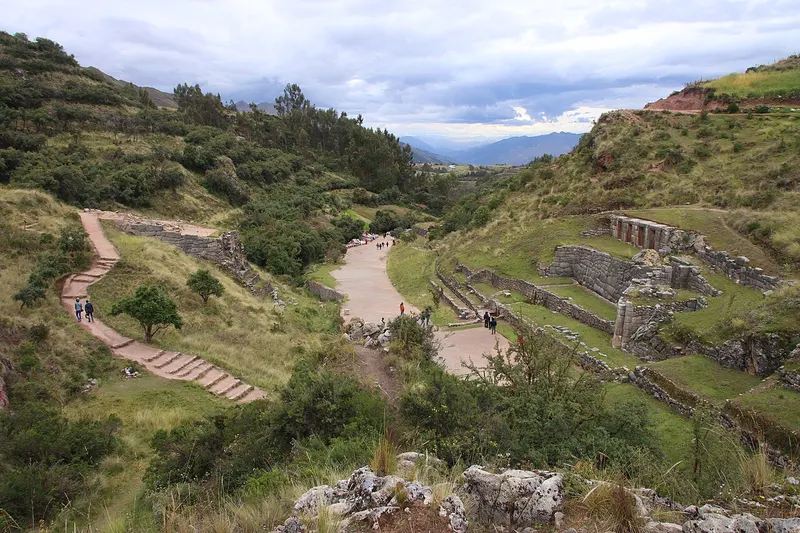
Plan around an hour. A path runs along the rim with the classic overlook of the largest, deepest set of concentric terraces, and you can walk partway down into the bowl on the projecting Inca steps if you'd like a closer look — just remember you'll have to climb back up at altitude, so take it slowly. There are smaller secondary depressions nearby for those who want to wander further. Read the rings as the Inca's likely agricultural laboratory, feel how the air warms as you descend, and you'll get far more from the stop than a quick photo.
The plateau is exposed and the sun fierce, even when the air feels cool, so a hat, sunscreen, water and a windproof layer all earn their place. If you're chasing the best light, the low morning sun rakes across the terraces and brings out their geometry; midday flattens them.
- Allow about an hour; the rim walk is easy, the descent into the bowl optional and a little effortful at altitude.
- Look for the smaller secondary terraces nearby if you want to explore further.
- Bring sun protection, water and a wind layer — the plateau is exposed.
At the Maras salt pans
Again, allow about an hour. The headline is the upper viewpoint, where the full cascade of thousands of pans falls away beneath you in white, cream, pink and ochre — one of the great sights of the valley. Access among the pans themselves has been tightened in recent years to protect the fragile salt and earthen walls, so most visiting is now from the designated viewpoints and marked paths rather than walking freely down between the basins; follow the posted rules and any guidance from the community.
Spend some of your hour at the salt stalls. The pink salt, salt flakes and salt-and-chocolate here are harvested by the families who own the pans, so buying a bag or two is both the best, most portable souvenir of the trip and the most direct way to support the community that maintains the site. If you photograph the salt-workers, do it respectfully — a smile, ideally asking first, and perhaps a purchase in return. And don't taste or take salt from the pans themselves; buy it from the stalls.
- Allow about an hour, centred on the upper viewpoint over the full cascade.
- Walking among the pans is now largely restricted — view from marked paths and follow posted rules.
- Buy the community's pink salt and flakes — the ideal light, local souvenir that supports the families.
- Photograph workers respectfully; don't take salt from the pans.
Adding it to a bigger day
Because the pair only really fills a half-day, many travellers bolt it onto a fuller Sacred Valley itinerary rather than making a special trip. The most natural extension is Chinchero, which sits on the same high road and pairs beautifully: open the day there with its weaving cooperatives, painted church on Inca foundations and terraces, then drop to Moray and the salt pans. From the plateau you can carry on down to Ollantaytambo — both a living Inca town and the train station for the citadel — making this a perfect last day in the valley before catching the train.
Alternatively, swing the loop the other way and combine the plateau with Pisac's market and ruins at the valley's Cusco end, though that makes for a long, full day with a lot of driving. However you knot it together, keep the altitude in mind: the plateau is high, so don't pack a first-day-off-the-plane itinerary with too much climbing.
- Easiest add-on: Chinchero first, then Moray and Maras — they're on the same high road.
- Continue down to Ollantaytambo to end the day at the train station for the citadel.
- A bigger loop can include Pisac, but that's a long, drive-heavy day.
- Mind the altitude — don't overload a day on the high plateau early in the trip.

What to bring, and a few cautions
Pack for a high, sunny, exposed plateau. Sun protection is the priority — a wide hat, high-factor sunscreen and sunglasses — because the altitude sun is fierce and the glare off the salt pans is intense even on cool days. Bring water, a windproof layer, and sturdy shoes for the uneven paths and the climb back up from Moray's bowl. Carry cash in soles for the salt-pans fee, the salt stalls and any taxi or moto-taxi, since card payment isn't reliable up here.
A couple of cautions to close on. First, never assume the colectivo-and-taxi budget route includes a guaranteed ride back — fix the return before you head down to the pans. Second, treat every detail that can change — tour and transport prices, the exact ticket costs, opening hours and the current access rules among the salt pans — as something to verify locally rather than take from any guide written in advance.
- Bring: hat, sunscreen, sunglasses, water, a wind layer, sturdy shoes — and cash in soles.
- Card payment is unreliable on the plateau; the salt fee and stalls want cash.
- On the budget route, lock in your return ride before going down to the pans.
- Verify prices, hours and access rules locally — they change.
At a glance
The half-day essentials in one place. The route and rhythm are evergreen; prices, hours and access rules change, so verify them locally.
- What it is: Moray's circular terraces plus the Maras salt pans, minutes apart — the classic Sacred Valley half-day.
- From: Cusco (~5–6 hrs door to door) or, more easily, a Sacred Valley base (a short morning).
- How: guided tour, hired taxi/driver, colectivo-plus-taxi on a budget, or self-drive.
- When: go early for the best light and fewest crowds; allow ~1 hour at each site.
- Tickets: Moray on the Boleto Turístico; the salt pans a separate community fee — bring cash and verify both.

Related guides

Moray: The Inca's Circular Terraces
The concentric terraced bowls on the plateau above the Sacred Valley — what they are, the leading theory that they were an Inca agricultural laboratory, the microclimates between the rings, how to get there, the Boleto Turístico, time needed, and pairing with the Maras salt pans.
Read guide
The Maras Salt Mines (Salineras de Maras)
The cascade of hand-worked salt-evaporation pools above the Sacred Valley — how the spring-fed pans work, the community that owns them, getting there, the separate entrance fee, photography and visitor etiquette, and pairing with Moray.
Read guide
Sacred Valley Itinerary: One or Two Perfect Days
A loop-by-loop Sacred Valley itinerary linking Písac, Urubamba, Maras and Moray, Chinchero and Ollantaytambo — paced for altitude and built to end at the train to Machu Picchu rather than back in Cusco.
Read guideMore in Sacred Valley
6
Best Hotels in the Sacred Valley
A curated shortlist of where to sleep in the Sacred Valley before Machu Picchu — sorted by what each does best: shortest train day, gardens and acclimatization comfort, family space, honeymoon luxury and value.
Read guide
Chinchero: Weaving, Terraces & the High Plateau
The 'birthplace of the rainbow' on the plateau above the Sacred Valley — its living weaving tradition, the church built on Inca foundations, the terraces, the Sunday market, and how the new airport and a valley loop fit around it.
Read guide
Family Hotels in the Sacred Valley
Where families should sleep in the Sacred Valley before Machu Picchu — garden resorts with lawns and pools, family rooms, easy meals, low-altitude comfort and smooth train-day logistics.
Read guide
Hiring a Private Driver in the Sacred Valley
When a private driver beats a group tour in the Sacred Valley — the flexibility, the off-road plateau sites, families and luggage, citadel-morning transfers, and realistic route ideas with honest timing.
Read guideLuxury Sacred Valley Hotels
The Sacred Valley's high-end lodges, spa retreats and honeymoon bases — destination hotels where pampering doubles as low-altitude acclimatization before Machu Picchu.
Read guide
Ollantaytambo: A Living Inca Town Guide
The Sacred Valley's most atmospheric staging base — a fortress town where the Inca street grid is still lived in, the train to Machu Picchu departs, and an early citadel morning becomes a short walk to the platform.
Read guide