
Trains to Machu Picchu
PeruRail vs IncaRail, Cusco vs Ollantaytambo departures, the service classes, stations, the strict luggage allowance, bimodal road-and-rail options, and where the train fits in the booking order.

- ✓Two operators run the line — PeruRail and IncaRail — and both end at Aguas Calientes, the town below the citadel.
- ✓Most departures leave from Ollantaytambo in the Sacred Valley; some bimodal services pair a bus from Cusco with the train for the lower stretch.
- ✓Classes range from comfortable panoramic tourist trains to the luxury Hiram Bingham; pick by budget and view, not speed.
- ✓Trains carry a strict, modest luggage allowance — leave the big bag in Cusco or Ollantaytambo and travel up with a daypack.
Two operators, one gorge
The train into Machu Picchu is one of travel's great set-pieces: a slow descent along the Río Urubamba as the dry highlands give way to dripping cloud forest, the cliffs closing in, the river running white below the window. Two companies share the standard-gauge line — PeruRail, the long-established operator, and IncaRail — and both deliver you to the same place, Aguas Calientes station, a short walk from the bus stop for the final climb to the gate.
The choice between them is mostly about schedule, price and the particular class you want, not about destination or quality of the basic experience. Both run frequent services through the day; both offer panoramic windows on their tourist trains; both add premium tiers. The practical move is to fix your Machu Picchu entry slot first, then pick whichever operator has a departure that lands you in Aguas Calientes with time to spare.

At a glance: the train facts
The evergreen essentials. Exact times, prices and class names change — confirm them with the operators when you book.
- Operators: PeruRail and IncaRail, both ending at Aguas Calientes (Machu Picchu Pueblo) station.
- Main departure point: Ollantaytambo in the Sacred Valley; some services start higher near Cusco or run bimodal.
- Journey: roughly an hour and a half to two hours from Ollantaytambo, following the Urubamba gorge.
- Classes: panoramic tourist trains (the standard), premium observation cars, and luxury (PeruRail's Hiram Bingham).
- Luggage: a strict, modest allowance — typically one small bag or daypack per person; verify the current limit.
Where the trains leave from — Cusco vs Ollantaytambo
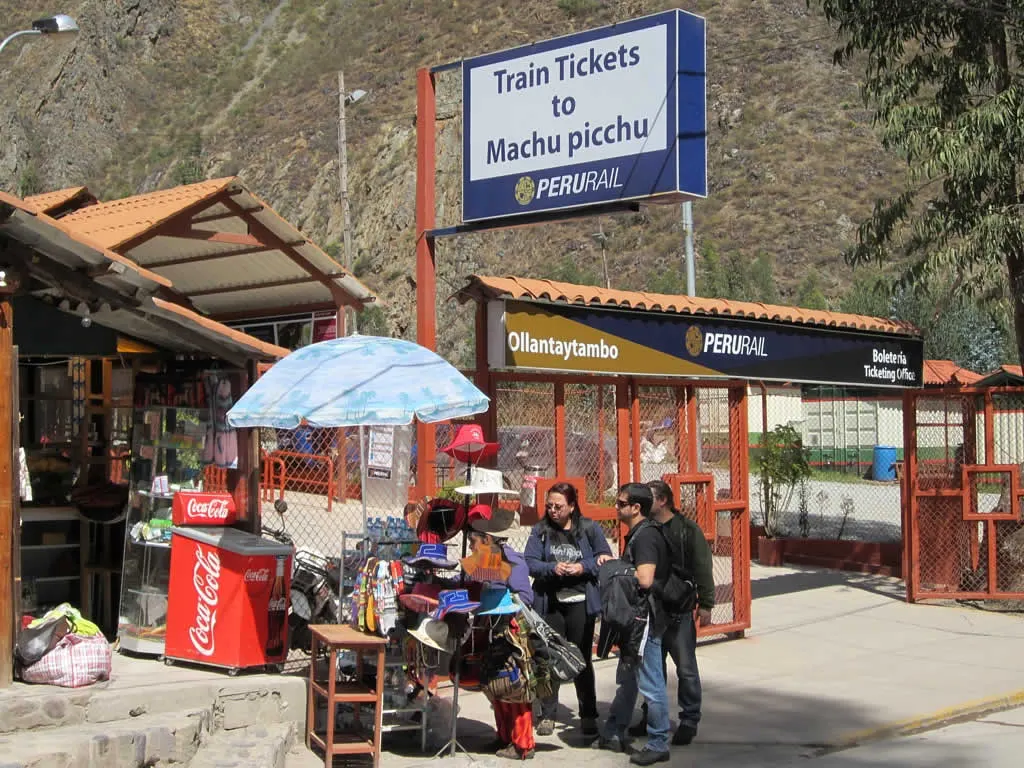
The single most useful thing to understand is the departure geography. The vast majority of services start at Ollantaytambo, deep in the Sacred Valley, because the section of line above it is slow, winding and prone to disruption. That is why so many itineraries spend the night before in Ollantaytambo or nearby Urubamba: you wake, eat breakfast, and step onto the platform a few minutes' walk away.
Getting to Ollantaytambo from Cusco is a road journey of roughly an hour and a half to two hours by taxi, colectivo or transfer. Some operators sell bimodal tickets that bundle this leg — a bus from Cusco down to a lower station, then the train onward — so you book one combined fare instead of arranging the road transfer yourself. A handful of services run from stations closer to Cusco at certain times of year, but Ollantaytambo is the dependable hub to plan around.

The classes — what you actually choose between
Both operators tier their service. At the everyday end sit the panoramic tourist trains — comfortable carriages with large side and roof windows, light refreshments, and a snug but pleasant ride; this is what most visitors take and it is more than good enough for the scenery. Above that come premium observation cars with bigger windows, open-air balconies and onboard service.
At the top sits luxury, most famously PeruRail's Hiram Bingham, a vintage-styled train with fine dining, a bar car and a price to match — a journey treated as the experience rather than the transit. IncaRail offers its own premium and private tiers. Choose by what you want from the ride: the standard tourist class gets you there in comfort, while the upper tiers turn the gorge into an event in itself.
Luggage — pack light, leave the rest
This trips people up more than anything else. Space on the trains is tight and the luggage allowance is strict and modest — broadly one small bag or daypack per person within a set weight. There is nowhere to wrestle a full suitcase aboard, and the rule is enforced. The fix is simple: leave your main luggage at your hotel in Cusco or Ollantaytambo (most hold bags for returning guests at no charge) and travel up to Aguas Calientes with only what you need for a night or two and the citadel visit.
Pack the day-of essentials in that bag — passport (the exact one on your ticket), entry ticket, layers for the changeable cloud-forest weather, water, sun protection and any altitude medication. You will be glad to be unencumbered both on the train and on the steep climb up to the gate.

Where the train fits in the booking order
It is tempting to book the train first — it is the part everyone pictures, and the booking sites are quick. But the train is the wrong anchor. Both operators carry far more passengers each day than the citadel gate admits in any time band, so seats are comparatively plentiful while the gate is the genuine bottleneck. Book a train before you hold an entry ticket and you risk committing to a day the citadel cannot take you.
Reverse it: lock the timed entry ticket first, then choose a train that lands you in Aguas Calientes comfortably before your slot, allowing time for the bus up and the gate queue. Never book the last possible train out so tightly that a delay strands you — and remember the final return service is firm. With the ticket fixed, picking a train is a calm ten-minute task.


Common questions about the trains
A few things travellers ask most often, kept evergreen — confirm the live specifics with the operators.
- Do PeruRail and IncaRail go to the same place? Yes — both end at Aguas Calientes (Machu Picchu Pueblo) station.
- Can I take the train all the way from Cusco? Usually you start at Ollantaytambo; bimodal tickets bundle a bus from Cusco. Verify current options.
- How long is the ride? Roughly an hour and a half to two hours from Ollantaytambo to Aguas Calientes.
- How much luggage can I bring? A strict, modest allowance — broadly one small bag per person; check the current limit before you travel.
- Should I book the train or the entry ticket first? The entry ticket — it is the capped bottleneck; trains have far more capacity.
- Do I still need the bus after the train? Yes — the shuttle bus (or a steep walk) covers the final climb from Aguas Calientes to the gate.
Verify before you book
Timetables, prices, class names, luggage limits and which stations are running shift with the season and the state of the line. The structure above is evergreen; the numbers are not. Confirm the current details directly with the operators when you book, and match your train to an entry ticket you already hold.
- Check current schedules, fares and the exact luggage allowance on the PeruRail and IncaRail sites.
- Confirm which departure stations and bimodal options are running for your dates.
- Book the citadel entry ticket first, then the train — never the other way around.


Related guides

PeruRail vs Inca Rail
A decision guide comparing the two operators on the Machu Picchu line — train classes, stations, luggage, schedules, and who each one suits.
Read guide
PeruRail to Machu Picchu
The operator's services to Aguas Calientes — Expedition, Vistadome, Vistadome Observatory and the luxury Hiram Bingham — with stations, baggage and booking notes.
Read guide
Inca Rail to Machu Picchu
The operator's services to Aguas Calientes — Voyager, the panoramic 360°, First Class and private trains — with the Ollantaytambo route, bimodal connection and station notes.
Read guideMore in Getting There
6
Aguas Calientes bus to the citadel
How the shuttle bus from Aguas Calientes (Machu Picchu Pueblo) up to the citadel gate works — buying tickets, the morning queue, timing it to your entry slot, and the walking alternative.
Read guide
Cusco airport to city & valley
Getting from Cusco's Velasco Astete airport to your hotel or the Sacred Valley — taxi, pre-booked transfer or hotel pickup — plus the altitude-first question of where to head after you land.
Read guide
Cusco to Machu Picchu: Every Way to Make the Journey
The realistic ways from the old capital to the citadel — train, bimodal bus-and-train, staging in the Sacred Valley, the long Hidroeléctrica back door, and whether a one-day round trip is sane.
Read guide
Cusco to Ollantaytambo
The ways to cover the road from Cusco to the rail gateway at Ollantaytambo — private driver, shared colectivo, tour transfer and taxi — plus the baggage strategy that saves you on the train.
Read guide
Lima to Cusco to Machu Picchu
Why getting from Lima to Machu Picchu is a staged journey, not a single hop — the flight to Cusco, the altitude jump, where to stage, and how to pace it so the citadel day actually works.
Read guide
Luggage Rules & Storage for Machu Picchu
Train baggage limits, where to leave the big bag in Cusco or Ollantaytambo, what to carry into the citadel, station storage in Aguas Calientes, and the trek-duffel system.
Read guide