 Around the Site
Machu Picchu Highlights: What You'll See
The set pieces inside the citadel — the Guardhouse overlook, the Temple of the Sun, the Intihuatana, the Sacred Rock, the Sun Gate and the Inca Bridge — and which circuit and route reaches each one.

Photo: Willian Justen de Vasconcellos / Unsplash
- ✓The postcard frame sits on the upper path near the Guardhouse, above the agricultural terraces — the one image everyone comes for.
- ✓The Temple of the Sun, the Intihuatana ritual stone and the Sacred Rock anchor the citadel's ceremonial heart.
- ✓What you actually reach depends on your circuit and route — the post-2024 system is largely one-way, so choose before you book.
- ✓The Sun Gate and the Inca Bridge are out-and-back walks tied to specific routes — decide early if you want them.
Reading the citadel before you walk it
Machu Picchu rewards a little reading. It is not a single monument but a whole small city in the clouds, divided between an agricultural sector of broad terraces and an urban sector of temples, plazas and houses, with ritual stones and gateways set deliberately among them. The Inca built it to be experienced as a sequence, and — fittingly — the modern visit is a sequence too: since the 2024 reorganisation, every ticket routes you along one of three circuits and a set of numbered routes, largely one-way, with no backtracking.
That makes this list more than a wishlist. The highlights below are the citadel's great set pieces, but no single ticket reaches all of them. Read them first as a way of deciding what matters most to you — the panoramic overlook, the temples, the ritual stones, the high walks — and then choose the circuit and route that delivers those. Capacities, exact route names and which landmark sits on which path are set by the Ministry of Culture and do change, so treat anything specific you find on official sources as current and verify when you book.


The classic overlook and the Guardhouse
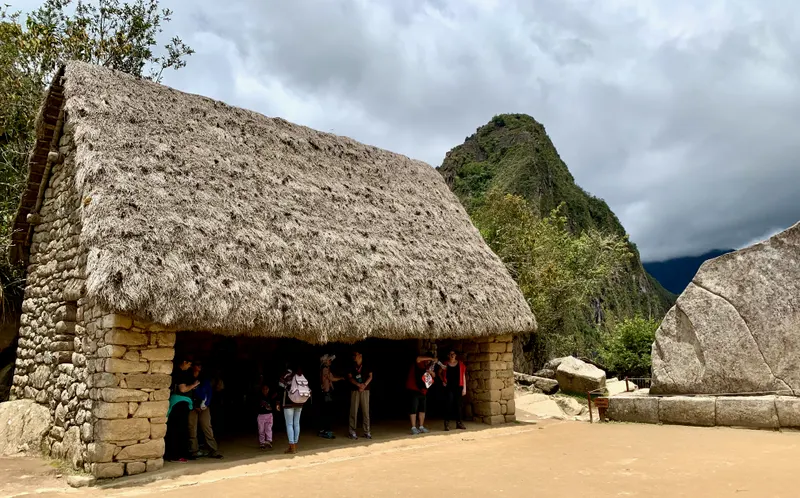
The image that brought you here — the whole city spread below with Huayna Picchu rising sheer behind it — is taken from the upper path on the agricultural side of the site, near the small thatched building usually called the Guardhouse (the Casa del Guardián or Recinto del Guardián). From this terrace the citadel resolves into the postcard: terraces stepping down, the urban sector beyond, the peak as a backdrop. It is the single most photographed viewpoint in South America, and for good reason.
This overlook sits on the upper, panoramic routes rather than down among the buildings, so reaching it is a matter of choosing a circuit that climbs to it. For the cleanest light, aim for early in your time window, before the sun is high and before the terrace fills — though cloud is common in the mornings and rolls through with its own slow drama. Nearby, a set of ceremonial terraces and a carved funerary rock add to the upper sector's quiet grandeur.
- What it is: the classic panoramic frame of the whole citadel with Huayna Picchu behind, from the upper terraces near the Guardhouse.
- Where: the upper, agricultural side of the site on the panoramic routes — not down among the buildings.
- Best light: early in your window before the terrace crowds; expect rolling morning cloud.
- Verify: which circuit/route reaches the overlook under current rules before you book.


The Temple of the Sun and the urban sector
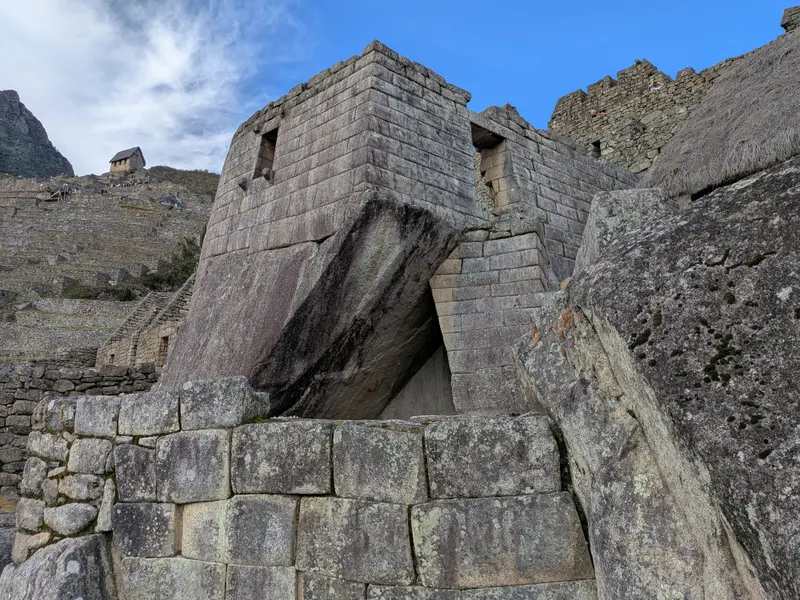
Down among the buildings, the Temple of the Sun is the citadel's masterpiece of stonework. Built on a great natural boulder, its curved wall — a rare rounded form in Inca architecture — encloses a window aligned to catch the rising sun at the June solstice, light falling precisely onto a carved stone within. Beneath it, a cave the early explorers called the Royal Tomb shows some of the finest carving on the whole site. The temple is reached on the lower, riverside circuit and is one of the strongest reasons to choose it.
Around the temple spreads the urban sector: the so-called Royal Residence, the Temple of the Three Windows and the Principal Temple grouped around the Sacred Plaza, a quarry where you can see how the stones were worked, and the warren of houses, stairways and water channels that made this a functioning settlement. Walking through it, the city stops being a view and becomes a place people lived — the detail of the joinery, the fit of the stones, the run of the water all close at hand.
- Temple of the Sun: a curved wall on a natural boulder, with a solstice-aligned window and the carved 'Royal Tomb' cave beneath.
- Sacred Plaza: the Temple of the Three Windows and the Principal Temple, the ceremonial core of the urban sector.
- The quarry, houses, stairways and water channels show the citadel as a lived-in city, not just a viewpoint.
- The temples sit on the lower, riverside circuit — choose it if the stonework matters most to you.

The Intihuatana and the Sacred Rock
At the high point of the urban sector stands the Intihuatana, often translated as the 'hitching post of the sun' — a carved granite outcrop whose angled faces and projecting stub align with the movement of the sun across the year. Many such stones across the Inca empire were destroyed by the Spanish; Machu Picchu's survived, which is part of why the site feels so intact. It is among the most sacred-feeling spots in the whole citadel, and access to it is sometimes restricted to protect it — verify the current rules.
At the far, northern end of the urban sector sits the Sacred Rock, a large flat stone set on a low plinth, its silhouette echoing the shape of the mountain ridge behind it — a deliberate mirroring of the sacred landscape that is one of the recurring ideas at Machu Picchu. It marks the threshold to the trail up Huayna Picchu, and stands at the quieter end of the city, a good place to pause before turning back.
- Intihuatana: a carved granite ritual stone aligned to the sun, one of few to survive the colonial era; access may be restricted — verify.
- Sacred Rock: a large flat stone echoing the mountain ridge behind it, at the northern end of the urban sector.
- Both sit at the heart and far end of the urban routes — check which circuit reaches them under current rules.
The high walks: Sun Gate, Inca Bridge and the peaks
Beyond the city itself, several walks reach out from the citadel — and each is tied to a particular circuit or a separate permit, so they are decisions to make before you book, not on the day. Intipunku, the Sun Gate, is the original Inca eastern entrance, set on the ridge above the city; Inca Trail trekkers arrive through it, and ticket holders can climb up to it on an out-and-back from inside the site for the trekker's-eye view of the citadel from above. The Inca Bridge, on the opposite side, is a short, dramatic walk along a cliff-cut path to a heart-stopping gap in the trail once bridged by removable logs — a glimpse of how the Inca controlled access to the sanctuary.
The two peaks are the headline add-ons and the first to sell out. Huayna Picchu — the sheer green peak in every photograph — is a steep, exposed climb to ruins and views directly above the city, requiring a separate add-on permit on a specific circuit. Machu Picchu Mountain is the higher, longer, less vertiginous climb on the opposite side, with a wider panorama. Both are time-limited, capacity-controlled and tied to particular ticket types, so if you want one, build the whole booking around it.
- Sun Gate (Intipunku): the Inca Trail's grand entrance, or an uphill out-and-back for ticket holders on the right route.
- Inca Bridge: a short cliff-path walk to a dramatic log-bridged gap — a window onto Inca access control.
- Huayna Picchu: the steep, exposed peak above the city; a separate add-on permit that sells out earliest.
- Machu Picchu Mountain: higher, longer, less vertiginous, with the widest views; also a tied add-on permit.
- All four depend on your circuit or a separate permit — decide before booking, and verify current rules.


At a glance: matching highlights to your ticket
Use this as a planning shortcut, then confirm the specifics on official sources, which set the circuits, routes and any access restrictions and update them periodically.
- Classic overlook & Guardhouse: upper, panoramic routes — the postcard frame.
- Temple of the Sun, Sacred Plaza, urban sector: lower, riverside circuit — the finest stonework, up close.
- Intihuatana & Sacred Rock: the urban routes; the Intihuatana may have restricted access — verify.
- Sun Gate & Inca Bridge: out-and-back walks tied to specific routes — choose deliberately.
- Huayna Picchu & Machu Picchu Mountain: separate add-on permits on specific tickets — book earliest of all.
- Golden rule: read the highlights, pick what matters, then choose the circuit — the routes are one-way and you cannot backtrack.