
Moray: The Inca's Circular Terraces
The concentric terraced bowls on the plateau above the Sacred Valley — what they are, the leading theory that they were an Inca agricultural laboratory, the microclimates between the rings, how to get there, the Boleto Turístico, time needed, and pairing with the Maras salt pans.

Photo: Andrea Pasquali / Unsplash
- ✓Moray is a set of huge concentric Inca terraces sunk into the ground like circular amphitheatres, on the plateau above the Sacred Valley near Maras.
- ✓The leading interpretation is that it was an agricultural research station — the rings create distinct microclimates, with a notable temperature difference from top to bottom.
- ✓It sits around 3,500 m; entry is via the Boleto Turístico, not a standalone ticket — verify scope and price locally.
- ✓Most visitors pair Moray with the nearby Maras salt mines, just a short drive apart, as a half-day from Cusco or the valley.
An amphitheatre carved into the earth
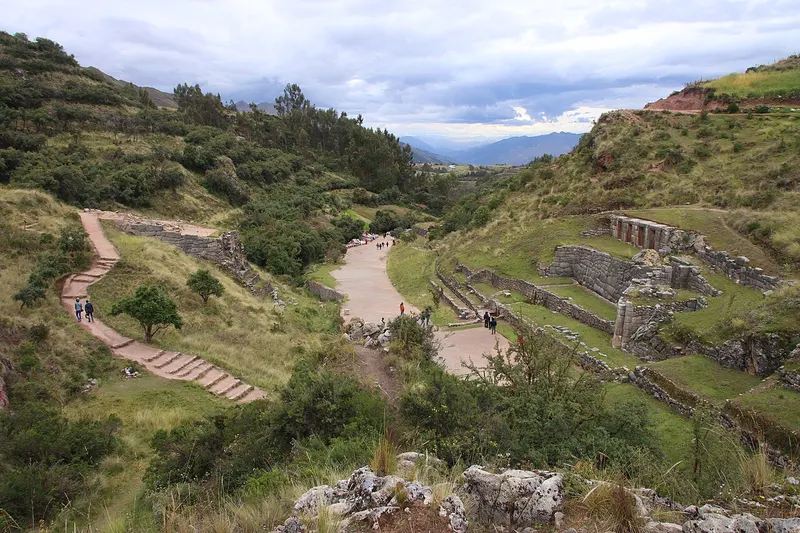
Come over the lip of the plateau near the town of Maras and the land suddenly drops away into something that looks almost too neat to be ancient: great concentric rings of terracing descending into a natural bowl, ring within ring, like an amphitheatre or a green target pressed into the earth. This is Moray, one of the strangest and most beautiful of all Inca sites, and one that photographs unlike anywhere else in the region. There are several such depressions here; the largest and most famous is a deep, near-perfect set of circular terraces that fall many tens of metres from rim to floor.
Each terrace is held by a fine Inca retaining wall and linked by the projecting stone steps the Inca used elsewhere, and the whole thing is fed by a sophisticated irrigation and drainage system that keeps the lowest level from flooding. Standing on the rim, it's hard not to feel you're looking at a piece of deliberate design rather than a quarry or a coincidence of geology — and most people who study it agree.


What was it for? The agricultural-laboratory theory
Nobody recorded Moray's purpose, so its function is interpreted rather than proven — but the most widely cited theory is striking: that it was an Inca agricultural laboratory, a place to experiment with crops. The argument rests on the microclimates. Because the bowl is sunk into the ground and faces the sun in a particular way, the conditions change markedly as you descend the rings — researchers have measured a meaningful temperature difference between the top terrace and the bottom, on the order of several degrees, with the lower, more sheltered levels warmer and the upper ones cooler and more exposed.
That spread of conditions, the theory goes, would let Inca agronomists test how crops — especially the many varieties of potato and maize on which the empire depended — fared at different effective altitudes, all in one place, acclimatising highland plants to lower zones or vice versa. Soil studies suggesting the terraces were filled with earth brought from different regions add weight to the idea. It remains a theory: some scholars are more cautious, and ceremonial or other uses can't be ruled out. But standing there, feeling the air warm as you walk down, the laboratory reading is hard to shake.
- The leading interpretation: an Inca agricultural research station for experimenting with crops.
- The sunken rings create distinct microclimates — a measurable temperature drop from the lowest, warmest terrace to the cool, exposed rim.
- Those microclimates could mimic different altitudes, ideal for testing and acclimatising potato and maize varieties.
- It's a theory, not a certainty — verify any specific figures, and other uses remain possible.
Getting there
Moray sits up on the Maras plateau, off the high road that runs between Chinchero and Urubamba, roughly an hour and a half or so from Cusco depending on the route and traffic. There's no public transport to the site itself; the practical ways to reach it are a guided Sacred Valley tour (which almost always includes it), a hired taxi or private driver for the day, or your own vehicle. A common budget approach is a shared colectivo from Urubamba or Chinchero to the town of Maras, then a taxi or moto-taxi out to Moray and on to the salt pans — workable, but you'll want to arrange the return.
However you arrive, the visit itself is gentle: a path runs along the rim with the classic overlook, and you can descend partway into the bowl on the terrace steps if you wish. The altitude here — around 3,500 m — is the only real effort, so take the climb back up to the rim slowly. The plateau is exposed, so bring sun protection and a layer for the wind.
- No public transport to the site — reach it by tour, taxi/private driver, or self-drive.
- Budget route: colectivo to Maras town, then taxi or moto-taxi to Moray (arrange the return).
- The walk along the rim is easy; descending into the bowl and climbing back is the only altitude effort (~3,500 m).
- Exposed plateau — bring sun protection, water and a windproof layer.

Tickets: the Boleto Turístico
There is no standalone Moray ticket. Entry is covered by the Boleto Turístico de Cusco, the regional tourist pass that bundles Moray together with a long list of other Sacred Valley and Cusco sites — typically including Pisac, Ollantaytambo and Chinchero, among others. Different versions of the boleto exist, including shorter partial passes that cover a sub-set of sites, so if your trip is centred on the valley a partial pass can be the better value. Buy it in advance or on arrival, bring it with you, and carry photo ID, as the pass can be checked at the gate.
Two things to confirm locally rather than trust to any guide written in advance: exactly which sites your version of the boleto covers, and the current price and validity — the Ministry sets these and they change. Note also that the Maras salt mines, which almost everyone pairs with Moray, are a separate community-run attraction with their own entrance fee, not part of the boleto.
- Moray is covered by the Boleto Turístico, not a separate ticket — buy the boleto in advance or on arrival.
- Partial-pass versions exist that cover a sub-set of sites — sometimes better value for a valley-focused trip.
- Verify the pass's current scope, price and validity locally; carry photo ID.
- The nearby Maras salt pans are a separate community fee — not included in the boleto.
How long to spend, and when to go
Moray itself is a fairly quick stop — half an hour to an hour is plenty for the rim view and a partial descent, longer if you walk down to the floor and back or visit the smaller secondary bowls. Because almost everyone twins it with the Maras salt mines a few minutes' drive away, plan the two together as a half-day; with travel from Cusco or the valley, the pair makes a comfortable morning or afternoon out.
For light and crowds, earlier is better. Mid-morning brings the tour buses, and the harsh midday sun flattens the terraces; soft morning or late-afternoon light rakes across the rings and shows their geometry far better. In the wet season (roughly November to March) the bowl is at its greenest but you'll want to dodge the afternoon showers, and the floor can be muddy. Whatever the season, the plateau sun is fierce at this altitude even when the air is cool.
- Allow roughly 30–60 minutes at Moray itself; longer if you descend to the floor.
- Pair it with the Maras salt mines a few minutes away — together they make a half-day.
- Morning or late afternoon gives the best light and fewer crowds; midday is busiest and flattest.
- Wet season (Nov–Mar) is greenest but showery and muddy; the high-altitude sun is strong year-round.
Pairing with the Maras salt mines
Moray and the Salineras de Maras are the natural pair of the plateau, only a short drive apart and almost always visited together. The two make a satisfying contrast: Moray is geometric, green and contemplative, an engineering puzzle to ponder from the rim; the salt pans are a dazzling, busy cascade of white and ochre terraces still being worked by hand exactly as they have been for centuries. Doing both in one half-day is the standard and best plan, and our dedicated half-day route lays out the timing and logistics.
If you only have appetite for one, choose by mood: Moray for the puzzle and the photography of pure form, the salt mines for living tradition and a livelier scene. But they're close enough that skipping either would be a shame.
- Moray and the Maras salt pans are a short drive apart and almost always seen together.
- Moray is geometric and contemplative; the salt mines are a living, working spectacle.
- Doing both as one half-day is the standard plan.
The engineering beneath the beauty
It's easy to be so taken with how Moray looks that you miss how cleverly it's built. The terraces aren't simply carved into a natural hollow; they're engineered. Each ring is faced with a fine stone retaining wall and backed with layers of fill — coarse stone for drainage at the base, then finer material, then topsoil — the same layered construction the Inca used for terracing across the empire, which is why these terraces have survived centuries of seasonal rain without collapsing or waterlogging. The lowest, deepest level of the main bowl, which by rights should pool with water, instead drains away, evidence of a deliberate underground drainage system worked into the design.
That drainage is part of what makes the agricultural-laboratory reading so persuasive: a research garden is only useful if its plots don't flood and rot, and Moray's builders clearly solved exactly that problem. Whether or not every detail of the crop-experiment theory holds, the construction makes one thing certain — this was a considered, expensive, high-status piece of work, not a casual quarry, and it speaks to how seriously the Inca took the science of growing food at altitude. Seen that way, Moray is a quiet companion to the grander terraces you'll meet at Pisac and Machu Picchu, all expressions of the same mastery of the mountainside.
- The terraces are layered for drainage — coarse stone, finer fill, then topsoil — the standard Inca technique that keeps them stable.
- An engineered drainage system stops the deep bowl from flooding, a clue to a deliberately functional design.
- The sophistication points to a high-status, purposeful site rather than a quarry or natural feature.
- It's of a piece with the terracing at Pisac and Machu Picchu — the same mastery of farming the mountainside.

At a glance
The Moray essentials in one place. The site and its leading theory are evergreen; ticket scope and prices change, so verify them locally.
- What it is: huge concentric Inca terraces sunk into the plateau like circular amphitheatres.
- Why it matters: most likely an Inca agricultural laboratory, its rings forming distinct microclimates.
- Altitude: around 3,500 m — easy rim walk, gentle climb back from the bowl.
- Ticket: covered by the Boleto Turístico, not sold separately — verify scope and price locally.
- Pair it with: the Maras salt mines next door, as a half-day from Cusco or the valley.

Related guides

The Maras Salt Mines (Salineras de Maras)
The cascade of hand-worked salt-evaporation pools above the Sacred Valley — how the spring-fed pans work, the community that owns them, getting there, the separate entrance fee, photography and visitor etiquette, and pairing with Moray.
Read guide
Chinchero: Weaving, Terraces & the High Plateau
The 'birthplace of the rainbow' on the plateau above the Sacred Valley — its living weaving tradition, the church built on Inca foundations, the terraces, the Sunday market, and how the new airport and a valley loop fit around it.
Read guideMaras & Moray: A Half-Day Route
A practical half-day plan for combining Moray's circular Inca terraces and the Maras salt pans — from Cusco or a Sacred Valley base. Transport options compared, the best order, timing for light and crowds, tickets, altitude notes and how to add it to a bigger valley day.
Read guideMore in Sacred Valley
6
Best Hotels in the Sacred Valley
A curated shortlist of where to sleep in the Sacred Valley before Machu Picchu — sorted by what each does best: shortest train day, gardens and acclimatization comfort, family space, honeymoon luxury and value.
Read guide
Family Hotels in the Sacred Valley
Where families should sleep in the Sacred Valley before Machu Picchu — garden resorts with lawns and pools, family rooms, easy meals, low-altitude comfort and smooth train-day logistics.
Read guide
Hiring a Private Driver in the Sacred Valley
When a private driver beats a group tour in the Sacred Valley — the flexibility, the off-road plateau sites, families and luggage, citadel-morning transfers, and realistic route ideas with honest timing.
Read guide
Luxury Sacred Valley Hotels
The Sacred Valley's high-end lodges, spa retreats and honeymoon bases — destination hotels where pampering doubles as low-altitude acclimatization before Machu Picchu.
Read guide
Ollantaytambo: A Living Inca Town Guide
The Sacred Valley's most atmospheric staging base — a fortress town where the Inca street grid is still lived in, the train to Machu Picchu departs, and an early citadel morning becomes a short walk to the platform.
Read guide
Písac Market: Textiles, Crafts & Etiquette
The famous artisan market in the Sacred Valley town of Písac — what to buy, how the timing and bargaining work, telling handwoven from machine-made, and how to fit the market and the hilltop ruins into one day.
Read guide