
Machu Picchu Pueblo station
Arrival and departure flow at the Aguas Calientes (Machu Picchu Pueblo) train station — the craft-market exit, finding your hotel, the bus stop, luggage, and timing your train to avoid the station scrum.
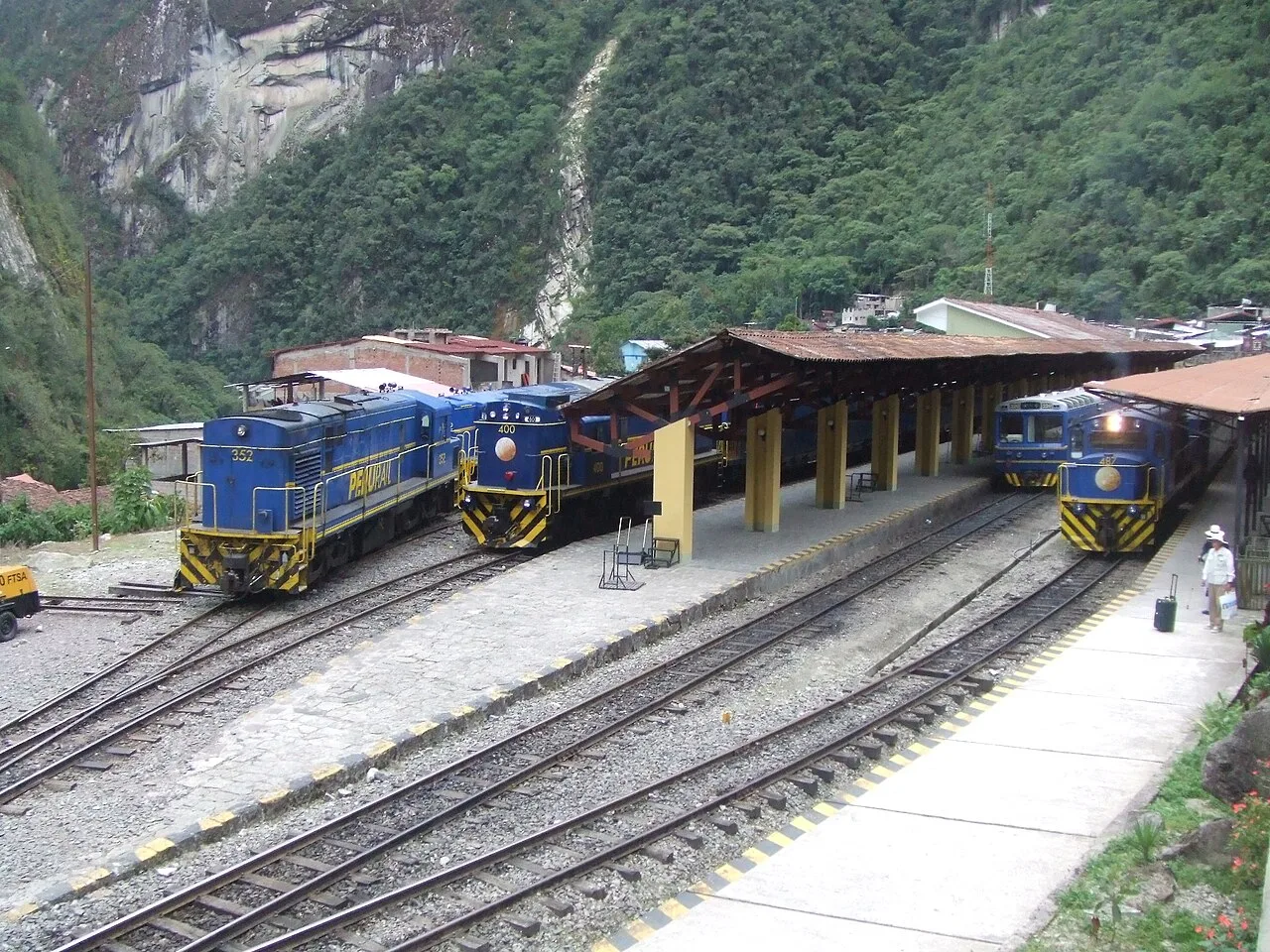
Photo: Hugh Llewelyn / Wikimedia Commons · CC BY-SA 2.0
- ✓The station sits right in the middle of Aguas Calientes — the town is small and walkable, so you don't need a taxi (there are barely any).
- ✓Arriving trains funnel you out through a craft market; it's the normal exit, not a wrong turn.
- ✓The bus stop for the citadel and the boarding queue are a short walk from the platform, down by the river.
- ✓There's a strict per-passenger luggage limit on the train, so the station handles small bags — leave the big suitcase in Cusco or Ollantaytambo.
Stepping off the train into the gorge
The train ride into the Urubamba gorge ends with a small theatre all its own. The carriages slow, the cloud-forest walls close in, the river roars alongside, and you step down onto the platform at Aguas Calientes — officially Machu Picchu Pueblo — in the middle of a town that exists almost entirely for the mountain above it. After the choreography of the journey so far, the station can feel briefly disorienting: there's no grand concourse, no taxi rank, just a platform, a river, a swirl of porters and arriving passengers, and a covered craft market you're funnelled straight into on the way out.
The good news is that this is one of the easiest stations in the world to navigate, once you know it's not really a station in the airport sense — it's a platform in a village you can cross on foot in ten minutes. This guide walks you through the arrival flow, how to find your hotel and the bus stop, what to do with your bags, and how to time your departing train so you're not standing in a scrum with your back to the river. Get the rhythm of it and the station stops being a chokepoint and becomes the simple hinge between the train and the mountain.

At a glance
The key facts for arrival and departure. Train timetables, operators and luggage allowances are set by PeruRail and IncaRail and change seasonally, so check your specific service; treat this as the orientation rather than a timetable.
- Name: Aguas Calientes station, in the town officially called Machu Picchu Pueblo — the end of the line.
- Operators: PeruRail and IncaRail both terminate here.
- Exit: arriving passengers walk out through a covered craft/artisan market — that's the standard route.
- Town size: tiny and walkable; almost no cars or taxis — you'll reach any hotel on foot.
- Bus stop: the citadel shuttle departs from a stop a short walk away, down by the river/bridge.
- Luggage: a strict per-person allowance on the train — bring a daypack, store the big bag up-valley.
What happens when I arrive?
Disembarking is straightforward but brisk. You step off onto the platform and are guided out along a fixed route that threads through the artisan market — rows of stalls selling alpaca knits, magnets and souvenirs. First-timers sometimes worry they've been herded somewhere wrong; you haven't. This is simply the only exit, by design, and you walk through it to reach the open town beyond. Keep moving, hold your bag close in the press of people, and you'll pop out within a couple of minutes onto the streets of Aguas Calientes proper.
From there, orientation is easy because the town is so compact. The river (the Vilcanota/Urubamba) runs through the middle, crossed by bridges; the main street, Avenida Pachacútec, climbs up toward the hot springs at the top; and the bus stop for the citadel is down near the river. If you've booked a hotel, many will send someone to meet arriving trains at the platform exit with a sign, especially the mid-range and upper places — a welcome help with the market crush. If not, your hotel is almost certainly a short, flat or gently uphill walk away; you won't need (and largely won't find) a taxi.
Finding the bus stop and the citadel shuttle
Once you've found your feet, the next landmark most people want is the bus stop, because the shuttle up the switchbacks is how you reach the citadel gate. It's a short walk from the station down toward the river, near the main bridge — you'll see (and in high season, hear) the queue and the green-and-white shuttle buses. The bus ticket is a separate purchase from your timed entry ticket and your train ticket, sold at the operator's office in town or online in advance, so sort that out before the morning rush rather than in it; check the current operator and fare on the official site.
If you arrive the day before your citadel slot — the usual and wise plan — you don't need the bus stop until morning. Use the afternoon to locate it, buy your bus ticket, and check exactly how long it takes from your hotel door, so the dawn start is a known quantity rather than a panic. If you're attempting a same-day turnaround (train in, citadel, train out), the walk from platform to bus queue is part of a tight clock, and timing it tightly matters even more.
What about luggage?
Luggage is the thing that trips up newcomers, and it's decided long before you reach the station. The trains into the gorge enforce a strict per-passenger allowance — a single bag of limited weight and size, plus a small daypack — because the carriages are narrow and storage is tight. That means the practical move is to leave your main suitcase behind in Cusco or Ollantaytambo (most hotels there hold luggage for guests heading to Machu Picchu) and travel into Aguas Calientes with just an overnight daypack. You'll be glad of the light load on the market exit and the town's stairs.
At the citadel itself the restrictions tighten further: large bags aren't allowed inside, and there's a small left-luggage facility near the entrance gate up top for anything oversized. So the chain is: big bag stored up-valley, small overnight bag in Aguas Calientes, and only the bare essentials — water, a snack, rain layer, passport and tickets — carried into the ruins. Plan the bags this way and the station, the bus and the gate all flow without a hitch.
- The train has a strict per-person luggage limit — typically one bag plus a small daypack.
- Leave the big suitcase in Cusco or Ollantaytambo; hotels there commonly store luggage.
- Travel into Aguas Calientes with just an overnight daypack.
- Large bags aren't allowed in the citadel; there's left-luggage near the entrance gate.
Getting your bearings: the town around the station
Because the station is the hub everyone passes through, it's worth a moment to map the town from it, so you're never far from a reference point. Stand at the platform exit and the river is your anchor: it runs through the centre, crossed by a couple of bridges, with the streets climbing away on either side. The main artery, Avenida Pachacútec, leads uphill from near the central square to the hot springs at the very top of town — a useful spine to navigate by. The small main square, with its church and statue, is a short walk from the platform and the place most hotels and restaurants orient themselves around.
Everything you need clusters within these few blocks: hotels at every price point, the warren of restaurants and bakeries, the artisan market by the station, the bus office and the bus stop down by the river, and the springs at the top. There are no real roads out — the train line and the trails are the only ways in and out — which is precisely why the town feels self-contained and walkable. After the bustle of the platform, take five minutes to walk the main loop (square, river, bus stop, the foot of Pachacútec) and the whole place will click into a shape you can move around confidently in the dark of an early start.
Timing your departing train
Leaving is where good timing saves a lot of stress, because departures from Aguas Calientes cluster and the small station gets busy. You can't just turn up and hop on — trains are reserved, seat-specific and run to a schedule, and the operators ask you to be at the platform a set time before departure with your ticket and passport ready. Aim to be back from the citadel and at the station with comfortable margin: late morning and afternoon trains are popular, and the platform fills quickly as several services come and go.
Build your departure backwards from the train time. Allow for the bus down from the citadel (or the walk), a beat in town to collect your bag and eat, and the walk to the platform. If your slot at the ruins is early, you'll often have the citadel done and be down in time for an early-afternoon train with room to spare; if your slot is later, give yourself an honest cushion so a slow bus queue doesn't cost you the train. Keep your ticket and the passport you booked with to hand — both are checked — and you'll board calmly rather than at a run.
- Departing trains are reserved and scheduled — be at the platform ahead of time, not just before.
- Work backwards: bus/walk down, bag collection, food, then the platform.
- Have your train ticket and passport ready; both are checked.
- Several services depart close together, so the small station fills fast — arrive with margin.


Related guides
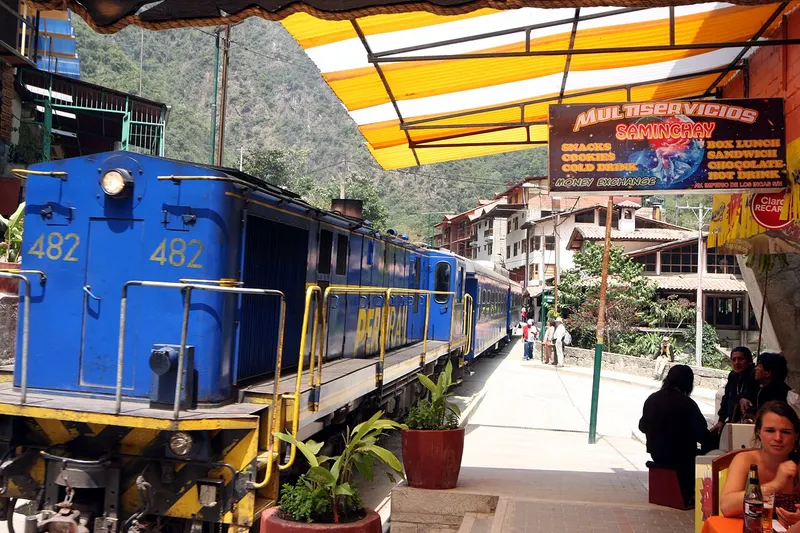
Aguas Calientes (Machu Picchu Pueblo): The Complete Guide
Aguas Calientes — officially Machu Picchu Pueblo — the cloud-forest town at the foot of the citadel. Where to sleep, how the trains and buses connect, the food, the hot springs, luggage, and how long to stay for a calmer entry.
Read guide
Aguas Calientes bus to the citadel
How the shuttle bus from Aguas Calientes (Machu Picchu Pueblo) up to the citadel gate works — buying tickets, the morning queue, timing it to your entry slot, and the walking alternative.
Read guide
Luggage Rules & Storage for Machu Picchu
Train baggage limits, where to leave the big bag in Cusco or Ollantaytambo, what to carry into the citadel, station storage in Aguas Calientes, and the trek-duffel system.
Read guideMore in Around the Site
6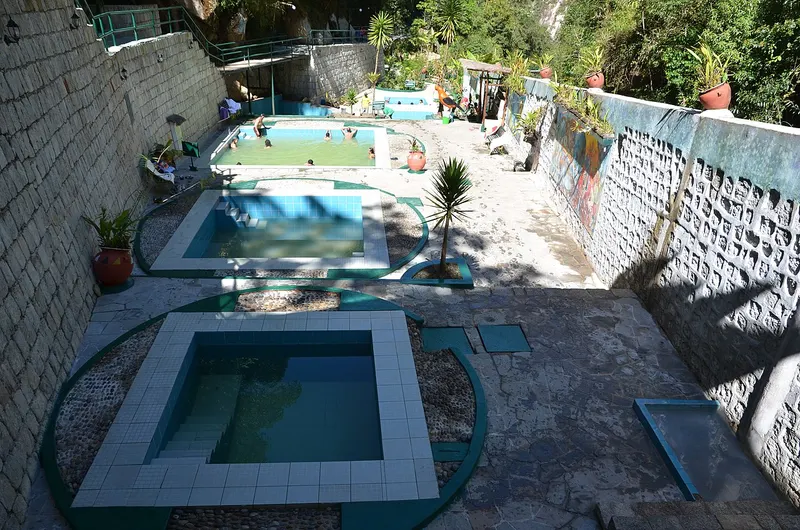
Aguas Calientes hot springs
The thermal baths that give Aguas Calientes its name — what to expect, when to go, what to bring, and whether they're worth a soak before or after the citadel or a long trek.
Read guide
Aguas Calientes restaurants
Where and how to eat in the town below Machu Picchu — the early breakfast that makes a dawn entry possible, the warm lunch on the way down, the celebratory dinner, and how to time meals around late trains.
Read guideBelmond Sanctuary Lodge
The only hotel beside the Machu Picchu entrance gate — who should splurge on it, what its location genuinely buys you, and the things it does not solve. An honest look at the citadel's most coveted address.
Read guide
Best hotels in Aguas Calientes
How to choose well among the hotels of the town below Machu Picchu — judged not on stars alone but on bus-queue and station proximity, river views, family fit, early breakfasts, luxury and value, and how cleanly each one sets up the citadel morning.
Read guide
Budget food in Aguas Calientes
How to eat well for less in Aguas Calientes (Machu Picchu Pueblo) — bakeries and set menús, market snacks, an early breakfast before the bus, and where the captive-market markups hide.
Read guide
Budget hotels in Aguas Calientes
How to sleep cheaply in the town below Machu Picchu without missing a train, a bus or your early entry — what a good budget room needs to get right, where the value sits, and the traps to dodge.
Read guide