
Cusco's Plaza de Armas: A Guide
The heart of the old Inca capital and the easiest place to find your feet at altitude — the cathedral, the Compañía de Jesús, the arcades, and how to use the square as the hub of a gentle first day.

Photo: Theo Topolevsky / Unsplash
- ✓The Plaza de Armas was the ceremonial centre of the Inca city — once a great square called Huacaypata — and is still where every Cusco day begins and ends.
- ✓Two great churches frame it: the cathedral on the north-east side and the Compañía de Jesús, the Jesuit church, on the south-east.
- ✓It's the perfect low-effort acclimatization base — flat, central, ringed with arcades, restaurants and pharmacies, a few minutes' walk from everything.
- ✓Sit on a balcony with a coca tea and watch the city; the square is a sight in itself and an antidote to overdoing the first day.
The square at the navel of the world
Cusco means 'navel' in Quechua, and the Plaza de Armas is the navel of the navel — the point the whole Inca empire was once measured from. In Inca times it was Huacaypata, a vast ceremonial plaza twice the size of today's square, the stage for the great festivals and the assembly of mummified ancestor-kings. When the Spanish arrived they built their churches and arcaded mansions straight onto the Inca foundations, which is why the plaza now reads as two cities at once: colonial arches and bell towers standing on the dark, perfectly fitted stone of the Inca.
For a traveller, all of that history is also extremely convenient. The plaza is flat, central and ringed with everything you need on a first, gentle day — restaurants and cafés under the arcades, pharmacies, tour offices, ATMs and a tourist information point. Whatever else you do in Cusco, you'll cross this square a dozen times, so it's the natural place to orient yourself the moment you arrive.
It helps to picture how the city is shaped. The Inca laid out Cusco, the legend goes, in the form of a puma, with the great fortress of Sacsayhuamán as its head and the Plaza de Armas roughly at its heart. Even if you take the puma loosely, the square really is the centre of gravity: streets radiate from it toward the market, the sun temple, the artists' quarter and the road out to the Sacred Valley. Learn the plaza and its exits on your first afternoon and the rest of Cusco stops feeling like a maze.

The two great churches
Two churches dominate the square, and travellers often confuse them. The grander, set back on the higher north-east side, is the Cathedral of Cusco — a vast complex begun in the sixteenth century, built partly with stone hauled from the Sacsayhuamán fortress above town, and home to a celebrated colonial-school painting of the Last Supper in which the centrepiece dish is a roasted cuy (guinea pig). It usually charges admission, often as part of a religious-circuit ticket; verify the current arrangement and hours locally, as they change.
Facing it across the square is the Iglesia de la Compañía de Jesús, the Jesuit church, with one of the most extravagant baroque facades in the Americas. The two were famously built in a kind of architectural rivalry — the story goes that the bishop complained the Jesuits' church was trying to outshine his cathedral, and the dispute reached the Pope before the Compañía was finished anyway. You don't need to go inside either to feel their weight — but if you have the energy and the time, the cathedral in particular rewards a slow visit. Just don't pack both into a fragile first afternoon at altitude.
If you do go in, slow down for the way the two cultures are layered here. The colonial Cusco School of painting, with its richly dressed angels and its blending of Andean and European imagery, fills these walls, and the very stones beneath your feet were quarried from Inca sites above the city. A church visit in Cusco is never just a church visit — it's a lesson in how the old capital was built on, over and out of what came before.
- Cusco Cathedral: north-east side, partly built from Sacsayhuamán stone; famous 'cuy' Last Supper painting inside.
- Compañía de Jesús: south-east side, an exuberant baroque Jesuit facade — a rival to the cathedral.
- Admission and hours apply and change — check the current religious-circuit ticket and opening times on the day.
Reading the arcades and the streets that lead off
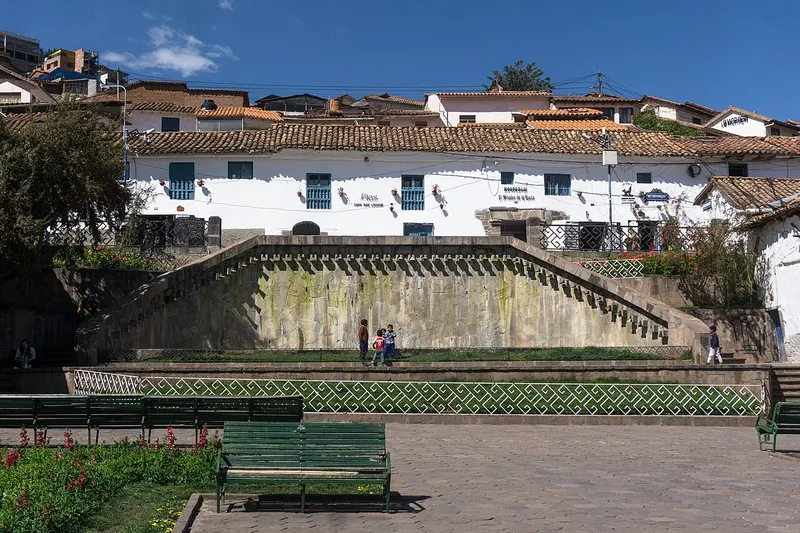
Spend a few minutes walking the arcades (the portales) that wrap the square and you'll start to understand Cusco's geography, which makes everything else easier to find. From the plaza, the steep lane of Triunfo and Hatun Rumiyoc climbs north-east toward San Blas — and it's on Hatun Rumiyoc that you'll find the famous twelve-angled stone, a single Inca block cut to lock against its neighbours on twelve faces. Downhill and west, streets run toward the San Pedro market and Plaza San Francisco; south, Avenida El Sol leads to the Qorikancha sun temple and, further on, the bus and rail connections.
It's worth doing this orientation loop slowly on your first day precisely because it asks nothing of you. You're learning the map, taking photographs, finding tomorrow's breakfast spot — all at a pace the altitude is happy with.
- Up Hatun Rumiyoc toward San Blas: pass the twelve-angled stone, a masterpiece of Inca masonry.
- Down toward San Pedro market and Plaza San Francisco for everyday Cusco life and food.
- South down El Sol to the Qorikancha sun temple and the onward transport hub.

Eating, sitting and watching from the balconies
Part of the plaza's charm is purely social. Many of the upper-floor restaurants have balconies that look straight over the square, and an hour on one of them — nursing a coca tea or a pisco sour, watching the light move across the cathedral and the hills behind — is one of the great quiet pleasures of Cusco. It's also, conveniently, the ideal acclimatization activity: you're resting, you're hydrating, and you're sitting still while your body adjusts to the thin air.
Prices around the plaza run higher than the back streets, and you'll be approached by people selling tours, paintings, massages and photos with llamas — a polite 'no, gracias' is all it takes. For your best meals, drift a block or two off the square; for the view, the plaza balconies are unbeatable.
The square also shifts character through the day, and it's worth catching more than one of its moods. Mornings are quiet and clear-lit, good for photographs of the empty arcades before the tour groups arrive. Midday brings the bustle. But the plaza is at its most magical after dark, when the cathedral and the Compañía are floodlit, the fountain is lit, and locals come out to sit on the benches and the cathedral steps — a nightly, unforced piece of theatre that costs nothing to watch and asks nothing of your lungs.

The square through the festival calendar
The plaza is not only Cusco's everyday hub — it is the stage for the city's great festivals, and if your trip lands on one you'll see the square at its most alive. At Easter, Holy Week reaches its climax here: on the afternoon of Holy Monday the Señor de los Temblores, the dark-skinned 'Lord of the Earthquakes' carried out of the cathedral, is processed around the Plaza de Armas while people on the balconies shower the litter with red ñucchu flowers. In June the square feeds into Corpus Christi and the Inti Raymi season, and on Christmas Eve it transforms completely for Santurantikuy, when artisans from across the southern Andes spread their stalls edge to edge and the whole centre becomes one vast open-air craft fair.
None of this needs planning to enjoy — the processions and the market happen in the very square you'd cross anyway — but the dates reshape hotels, trains and tickets, so it's worth knowing which festival you're arriving into. Exact dates for the movable feasts change each year; confirm them before you build a day around one.


At a glance
The essentials for using the Plaza de Armas as your Cusco hub. The Inca and colonial history is evergreen; church admissions, hours and the religious-circuit ticket change, so verify them on the day.
- What it is: Cusco's central square, the Inca ceremonial plaza of Huacaypata, now ringed with colonial arcades.
- See: the cathedral, the Compañía de Jesús, and the twelve-angled stone a short climb up Hatun Rumiyoc.
- Effort: flat and central — the lowest-effort base for a first day at 3,399 m.
- Use it to: orient yourself, find food and pharmacies, and rest on a balcony while you acclimatize.
- Tickets: church entry and hours apply and change — verify locally before queuing.
Folding the plaza into your first day
Because the square is the hub of the historic centre, it slots naturally into the start and finish of a gentle arrival day. A typical rhythm: ease in over a late breakfast under the arcades, do the slow orientation loop, look into one church if you have the energy, then retreat to a balcony for the afternoon as the altitude settles. Save the bigger sights — the Qorikancha, the hilltop ruins, San Blas's viewpoints — for once you've slept on the height.
Treat the plaza as the room you keep returning to, not a box to tick. It's the safest, most rewarding place in Cusco to do very little, which on your first day is precisely the goal.
Related guides

Where to stay in Cusco
A neighbourhood-by-neighbourhood guide to basing in Cusco before Machu Picchu — weighing altitude comfort, charm, walkability, station and airport access, and which area suits families, couples, luxury and budget travellers.
Read guide
Cusco Cathedral: The Plaza de Armas Centrepiece
The great colonial cathedral on Cusco's Plaza de Armas — built on Inca foundations, hung with Cusco School paintings, and home to the famous guinea-pig Last Supper. Tickets, art, dress code and how it fits a first acclimatizing day.
Read guide
Your First Day in Cusco: A Gentle Itinerary
An altitude-friendly plan for arrival day in Cusco — slow, flat and central, but still a real Cusco day. How to pace the hours from a late breakfast to a balcony dusk while your body adjusts to 3,399 m.
Read guideMore in Cusco Base
6
Best Cafés in Cusco
Where to take coffee, breakfast and a gentle acclimatization morning in Cusco — the plaza spots, the San Blas hideaways and the quieter local lanes, mapped for couples easing into the altitude.
Read guide
Best hotels in Cusco
How to choose well among Cusco's hotels for a Machu Picchu trip — judged not on stars alone but on altitude comfort, location and walkability, character, family fit, and how cleanly they set up the onward journey to the citadel.
Read guide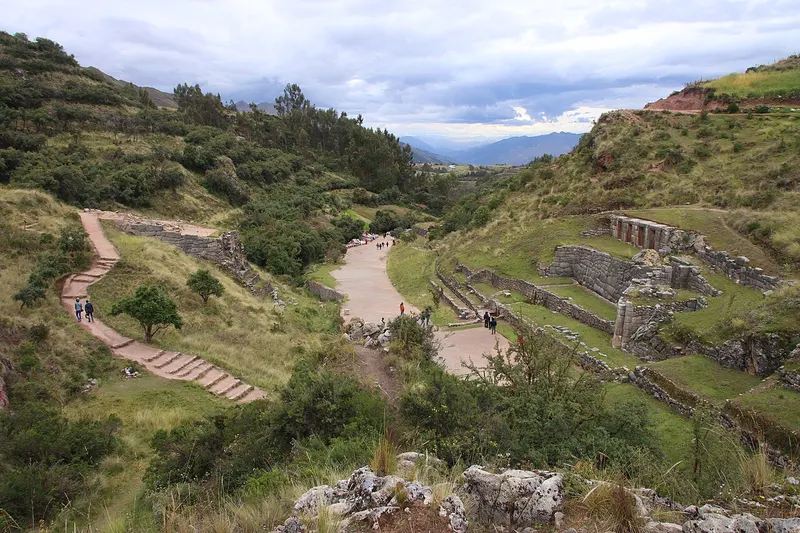
Boleto Turístico del Cusco
How the COSITUC Boleto Turístico works — the combined pass that covers Sacsayhuamán, Pisac, Ollantaytambo, Moray, the Maras–style sites and a clutch of Cusco museums — and when it's actually worth buying.
Read guide
Budget hotels in Cusco
How to sleep well in Cusco for less before Machu Picchu — value hotels, guesthouses and hostels, where the cheaper rooms cluster, and the few things never to scrimp on at 3,399 m.
Read guide
Cusco & Machu Picchu Costs
A realistic way to think about the money — the fixed citadel ticket, the train that dominates the budget, buses, guides, food and the trek add-ons — and where the costs hide.
Read guide
Cusco acclimatization & altitude
How to land soft in Cusco at 3,399 m: reading soroche, pacing your first day, what to eat and drink, the easy activities that help, and when to simply rest before Machu Picchu.
Read guide