
Machu Picchu History: The Story in the Stone
Who built Machu Picchu and why, the engineering that holds a city to a ridge, the centuries of quiet, Hiram Bingham's 1911 arrival, and the UNESCO status that shapes how we visit today.

- ✓Machu Picchu was built in the mid-15th century, most likely as a royal estate associated with the Inca ruler Pachacuti.
- ✓It was never found or destroyed by the Spanish, which is why so much of it survives intact — a rare unbroken Inca site.
- ✓The American explorer Hiram Bingham reached it in 1911 and brought it to world attention, though local people had never forgotten it.
- ✓It is a UNESCO World Heritage Site and a protected sanctuary — the timed tickets and fixed circuits exist to keep it standing.
A royal estate in the clouds
Machu Picchu was built around the middle of the 15th century, during the great expansion of the Inca empire, and the prevailing view among scholars is that it served as a royal estate — a retreat and ceremonial centre associated with the ruler Pachacuti, the emperor who transformed the Inca from a regional power into the largest state the Americas had ever seen. It was not a city in the sense of a teeming capital like Cusco, nor a fortress in any military sense, despite the romantic label. It was a place of stone temples, fine residences, terraced fields and ritual, set on a high ridge between two peaks where the Inca's sacred geography of mountains, sun and river all converged.
Understanding it as an estate explains much of what you see. The scale is grand but human; the architecture is ceremonial rather than defensive; and the whole site is woven into its landscape, with temples that frame and echo the surrounding peaks, windows aligned to the solstice sun, and a carved ritual stone that 'ties' the sun to the place. The Inca did not build at random on this ridge — they read the mountains as sacred and built to honour them.
The engineering that holds a city to a ridge
What makes Machu Picchu astonishing is not only that the Inca built here, but that what they built has stayed standing for over five centuries on a steep, wet, earthquake-prone mountainside. The genius is largely invisible. Beneath the visible terraces and walls lies a vast hidden infrastructure of drainage — layered fill of rock, gravel and soil that channels the heavy cloud-forest rain down and away rather than letting it pool, swell and slump the slope. The terraces that step down the hillside are as much engineering as agriculture: they stabilise the ground, manage water and create the level platforms the city stands on.
Above ground, the stonework is the marvel everyone recognises. The finest walls are built of granite blocks shaped and fitted so precisely that no mortar is needed and a knife blade will not slide between them — a technique that also lets the walls flex slightly and settle back during the tremors that regularly shake the Andes. Trapezoidal doorways and windows, walls that lean subtly inward, and stones with many faces all add seismic resilience. The Inca had no iron tools, no wheel and no written plans as we'd recognise them, yet they quarried, shaped and raised this on a knife-edge ridge using stone, bronze, rope, ramps and an extraordinary command of how stone behaves.
- Hidden drainage layers of rock, gravel and soil carry the cloud-forest rain away and keep the slope stable.
- Terraces are structural — they hold the mountain in place and create the platforms the city sits on.
- The finest walls use mortarless, precisely fitted granite that flexes and resettles during earthquakes.
- Trapezoidal openings and inward-leaning walls add seismic resilience — engineering without iron or the wheel.
Abandonment and the long quiet
Machu Picchu was used for only a relatively short time. Within roughly a century of its building, the Inca world was thrown into crisis: civil war between rival heirs, then the arrival of the Spanish in the 1530s, the fall of the empire, and the epidemics that swept ahead of and behind the conquest. The estate was abandoned — quietly, it seems, rather than violently. Crucially, the Spanish never found it. Tucked away on its remote ridge above the gorge, off the main routes, it escaped the looting and demolition that levelled so many Inca temples elsewhere, where churches were deliberately raised on the ruins of sun shrines.
That is the single most important fact about how Machu Picchu reaches us. Because no conquistador climbed to it, no one tore down its temples or smashed its Intihuatana, and so the site survives as one of the most complete Inca complexes anywhere. For some four centuries it sat under encroaching cloud forest, known to local farmers who worked parts of the terraces and to the families living in the valley, but unknown to the wider world. It was never truly 'lost' — only quiet.
1911: Bingham and the world's arrival
The moment Machu Picchu entered global consciousness came in July 1911, when the American historian and explorer Hiram Bingham, guided by local people, climbed to the ridge and found the overgrown city. Bingham was looking for Vilcabamba, the last refuge of the Inca resistance, and for a time believed Machu Picchu was it — a theory later set aside. What he had actually reached was the royal estate, and his photographs and writings, amplified by the National Geographic Society, turned an obscure ruin into one of the most famous places on earth.
It is worth holding the story honestly. Bingham did not 'discover' Machu Picchu in any meaningful sense — local farmers were living on and around the site and led him to it, and earlier outsiders had reached it too. His real contribution was to document it, excavate it and broadcast it to the world. His expeditions also removed thousands of artefacts to Yale University, the subject of a long dispute that was eventually resolved with their return to Peru, and a reminder that the history of a famous site includes the history of how it was studied and contested.
- Hiram Bingham reached the overgrown citadel in July 1911, guided by local residents.
- He was searching for Vilcabamba, the last Inca refuge, and at first thought Machu Picchu was it.
- His photographs and National Geographic's reach made the site world-famous.
- Thousands of artefacts went to Yale and were later returned to Peru after a long dispute.

Protection, pressure and how we visit now
Machu Picchu was inscribed as a UNESCO World Heritage Site in 1983 — recognised for both its cultural value and the natural sanctuary around it — and it remains one of the most visited heritage sites in the Americas. That fame is also its threat. The sheer weight of visitors, in a place built for ceremony rather than crowds and set on an actively eroding mountainside, puts constant pressure on the stone, the soil and the drainage that holds it all together. Concern about over-tourism and its effect on the site has shaped management for decades.
This is why the modern visit looks the way it does. The timed-entry tickets, the fixed one-way circuits introduced and revised since 2024, the guide requirements, the caps on the add-on peaks and the restrictions on bags and conduct are not bureaucratic whims — they are the tools used to keep a fragile, irreplaceable place standing while still letting the world in. Knowing the history changes how the rules feel: you are not queuing through an attraction but moving carefully through a five-hundred-year-old sanctuary that survived the conquest precisely because it was left alone. The least we can do is walk it gently. Specific rules and capacities change, so confirm the current ones on official sources before you go.
- Inscribed as a UNESCO World Heritage Site in 1983, for both cultural and natural value.
- Among the most visited heritage sites in the Americas — and under real pressure from that popularity.
- Timed tickets, one-way circuits, guides and bag rules exist to protect a fragile, eroding site.
- Rules and capacities change — verify current ones officially before booking.

At a glance: the history in brief
A quick timeline to carry up the mountain. Dates and attributions reflect the prevailing scholarly view and continue to be refined by ongoing research.
- Mid-15th century: built, most likely as a royal estate associated with Pachacuti.
- Late 15th–16th century: in use for roughly a century before the Inca crisis and the Spanish arrival.
- 1530s onward: abandoned but never found by the Spanish — which is why it survives so intact.
- 1911: Hiram Bingham, led by local residents, brings the site to world attention.
- 1983: inscribed as a UNESCO World Heritage Site.
- Today: a protected sanctuary visited by timed ticket and fixed circuit — verify current rules.
Related guides

Machu Picchu Site Guide: Circuit by Circuit
How to read and walk the citadel under the post-2024 system — the three circuits, the landmarks each one reaches, the photo points, the order you move, and how to pace a one-way visit at altitude.
Read guide
Machu Picchu Highlights: What You'll See
The set pieces inside the citadel — the Guardhouse overlook, the Temple of the Sun, the Intihuatana, the Sacred Rock, the Sun Gate and the Inca Bridge — and which circuit and route reaches each one.
Read guide
Qorikancha: Cusco's Golden Sun Temple
The Inca empire's holiest sanctuary, sheathed in gold and now half-buried under the colonial church of Santo Domingo. What to see, how to read the stonework, and why it decodes Machu Picchu before you ever board the train.
Read guideMore in Highlights
6
A Rainy Day at Machu Picchu
Rain at the citadel is normal, not a disaster — how to dress for cloud forest, which circuits cope best, how to build train buffers, the Aguas Calientes backups, and why mist makes the most haunting photographs of all.
Read guide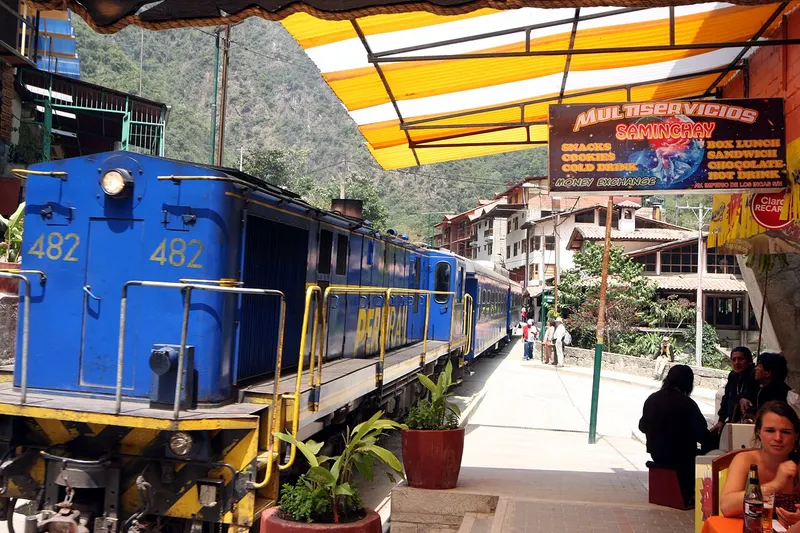
Aguas Calientes (Machu Picchu Pueblo): The Complete Guide
Aguas Calientes — officially Machu Picchu Pueblo — the cloud-forest town at the foot of the citadel. Where to sleep, how the trains and buses connect, the food, the hot springs, luggage, and how long to stay for a calmer entry.
Read guide
Around the Site: Machu Picchu Up Close
The hub for the world immediately around the citadel — what to see inside it, the town of Aguas Calientes below, where to stay, the first buses up, the hot springs, the restaurants, and how to visit responsibly.
Read guide
Best Photography Spots at Machu Picchu
Where the great Machu Picchu photographs are actually made — the classic upper-terrace frame, the llamas, the morning cloud, and which circuit reaches each angle. Plus the sunrise myth and what you simply cannot access.
Read guide
Budget hotels for Machu Picchu
Better-value places to sleep along the Machu Picchu route — honest guesthouses and well-run hostels in Cusco, Ollantaytambo and Aguas Calientes — chosen to stretch the trip without wrecking the altitude ladder or the citadel-morning logistics.
Read guide
Luxury hotels for Machu Picchu
The top-end stays that string together a polished Machu Picchu journey — restored monasteries and oxygen-equipped suites in Cusco, hacienda-and-spa retreats in the Sacred Valley, and the one true luxury option at the gate of the citadel itself.
Read guide