
A Luxury Machu Picchu Itinerary
A high-end Machu Picchu plan with palace hotels in Cusco, luxury Sacred Valley lodges, the Hiram Bingham train, private guiding and soft, altitude-kind pacing.

- ✓Luxury here buys time and ease, not shortcuts: the same timed-entry ticket and altitude ladder, wrapped in palace hotels, a private guide and a chauffeured pace.
- ✓Stage low and slow — a former monastery in Cusco, a lodge in the lower Sacred Valley — so the height never bites and every day feels unhurried.
- ✓The Hiram Bingham train turns the ride into the gorge from transit into an occasion, with a dining car, a bar and live music.
- ✓The one true luxury at the citadel is staying at the Belmond Sanctuary Lodge, the only hotel at the gate, for a dawn entry before the day-trippers arrive.
What luxury actually buys at Machu Picchu
Machu Picchu does not have a VIP entrance. The same timed-entry ticket, the same circuits, the same bus up the switchbacks and the same altitude apply to everyone, however they travel. What money buys here is not access but ease: a private guide who reads the stones for you and beats the crowds to the best viewpoints, a chauffeured pace that never has you queuing or rushing, palace hotels that turn the in-between days into the trip itself, and a luxury train that makes the gorge journey an occasion. The genius of a luxury Machu Picchu itinerary is that it spends its money on time, comfort and altitude-kindness — the three things that most improve the experience.
It is also, quietly, the gentlest way to do the trip. Soft pacing, lower-altitude lodges, oxygen-enriched rooms in the best hotels, and a private vehicle on call all blunt the soroche that catches out hurried budget travellers. The result is a week that feels less like an expedition and more like a slow, golden journey through the Andes, with the world's most famous ruin as its centrepiece.
This itinerary lays out the high-end version stage by stage. Treat the structure as fixed and the specifics — exact prices, train schedules, ticket circuits and hotel details — as things to verify directly with the properties and operators when you book, because those move with the season.


At a glance
The shape of a high-end visit before you commit. Altitudes and the general flow are stable; prices, train schedules, ticket circuits, hotel offerings and dining details move with the season and the operators, so verify those directly when you book.
- Pacing: slow and low — extra nights, lower-altitude lodges, a private vehicle on call.
- Cusco: a converted monastery or palace hotel, ideally with oxygen-enriched rooms, for the acclimatization days.
- Sacred Valley: a destination lodge in the lower valley with spa, gardens and a long, gentle stay.
- The train: the Hiram Bingham luxury service for the journey into the gorge.
- At the citadel: the Belmond Sanctuary Lodge at the gate for a dawn entry, or a top hotel in Aguas Calientes.
- Guiding: a private licensed guide throughout, and a private driver in Cusco and the valley.
- Booking order: timed-entry ticket → luxury train → hotels — the same as any trip.
Booking order: even luxury bows to the ticket
The one rule no amount of money rewrites is the booking order. Your Machu Picchu entry is a timed slot tied to one of the three official circuits — a fixed walking path through the citadel — and a luxury concierge cannot conjure a slot that has sold out. So the sequence is the same as for any trip: secure the entry ticket first (and the Huayna Picchu or Machu Picchu Mountain add-on permit if you want one), then book the luxury train that lands you in time for it, and only then arrange the hotels around both. For dry-season dates the best morning slots and the peak add-ons go weeks ahead, so a high-end trip is, if anything, a reason to book earlier, not later.
A good luxury operator or hotel concierge will handle all of this for you, but it is worth understanding the spine so you can ask the right questions. Confirm which circuit your ticket uses, whether your guide is private, and exactly how the train and bus connect to your entry window. The luxury is in never having to think about any of it on the day — but someone has to think about it in advance.


Cusco: a palace, a monastery, and easy first days
The trip begins in Cusco at 3,399 m, and the luxury version uses its first days to acclimatize in real comfort. The city's finest hotels are some of the most romantic in South America — a former Inca palace, a sixteenth-century monastery built around a stone cloister and an ancient tree, town houses hung with colonial art. Several offer oxygen-enriched rooms that take the edge off the altitude while you sleep, which is exactly the kind of small luxury that pays for itself on a trip like this.
Spend the first day or two doing very little, beautifully. A private guide can show you the Coricancha sun temple, the cathedral and the steep San Blas lanes at a gentle, chauffeured pace, ducking into the best textile galleries and stopping for a long lunch rather than marching a circuit. Keep the strenuous Sacsayhuamán climb light, drink the coca tea, and let the altitude settle. The point of Cusco at this end of a luxury trip is not to tick sights but to land soft, eat superbly, and ease your body into the height.

The Sacred Valley: a destination lodge, not a stopover
Where a standard itinerary treats the Sacred Valley as a corridor, a luxury one treats it as a destination — and the altitude logic agrees, since the valley floor (around 2,800 m) is lower and kinder than Cusco. The lower valley holds some of Peru's most extraordinary hotels: a hacienda set in terraced gardens, a lodge with a spa overlooking the Urubamba, a retreat with its own observatory and farm-to-table table. These are places worth two or three nights for their own sake, with spa treatments, riding, stargazing and long valley lunches, all while your body quietly finishes acclimatizing in the gentlest possible setting.
A private driver makes the valley sing. Rather than a coach circuit, you visit Moray's concentric terraces and the Maras salt pans in the best light, linger at Ollantaytambo's fortress when the day-trippers have gone, and stop wherever a view or a weaving cooperative tempts you. The valley days are where a luxury itinerary earns its keep — slow, restorative, and beautiful — and they leave you poised at the western end of the valley, calm and acclimatized, for the train into the gorge.

The Hiram Bingham: the train as an occasion
On a budget trip the train is transit; on a luxury trip it is an event. PeruRail's Hiram Bingham — named for the explorer who brought Machu Picchu to the world's attention in 1911 — is the line's flagship, a polished 1920s-styled train with a dining car, an observation bar with live Peruvian music, and a multi-course meal served as the gorge unrolls past panoramic windows. The ride into the cloud forest, snow peaks giving way to orchids and the Urubamba churning alongside, becomes a long, leisurely lunch or dinner rather than a journey to be endured.
Practically, the Hiram Bingham still ends where every train ends, at Aguas Calientes (Machu Picchu Pueblo), and it still connects to the bus up to the gate. The difference is purely in the experience of getting there and back. Many luxury itineraries ride it in one or both directions; some pair an early ordinary train up for a dawn entry with the Hiram Bingham back, when its dining and music suit a celebratory return. Even at the top of the market, leave the big bag behind — the luxury train carries an allowance too.
- The Hiram Bingham: dining car, observation bar, live music — the gorge as a long, leisurely meal.
- It ends at Aguas Calientes like every train and connects to the bus up to the gate.
- Consider an early ordinary train up for a dawn citadel entry, then the Hiram Bingham back to celebrate.
- A luggage allowance applies even here — travel up with an overnight bag.


Sleeping at the gate: the Belmond Sanctuary Lodge
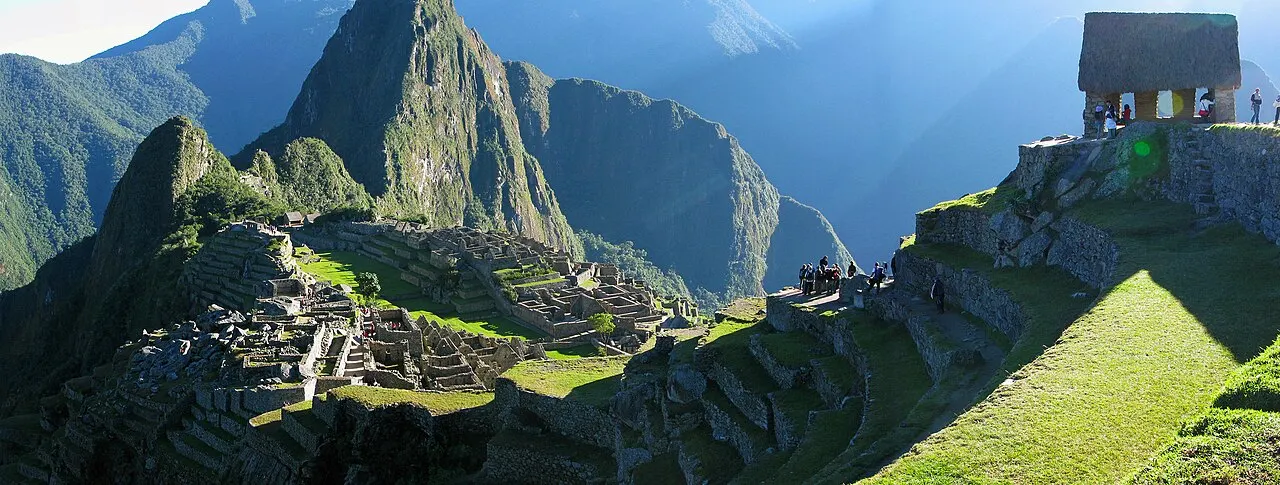
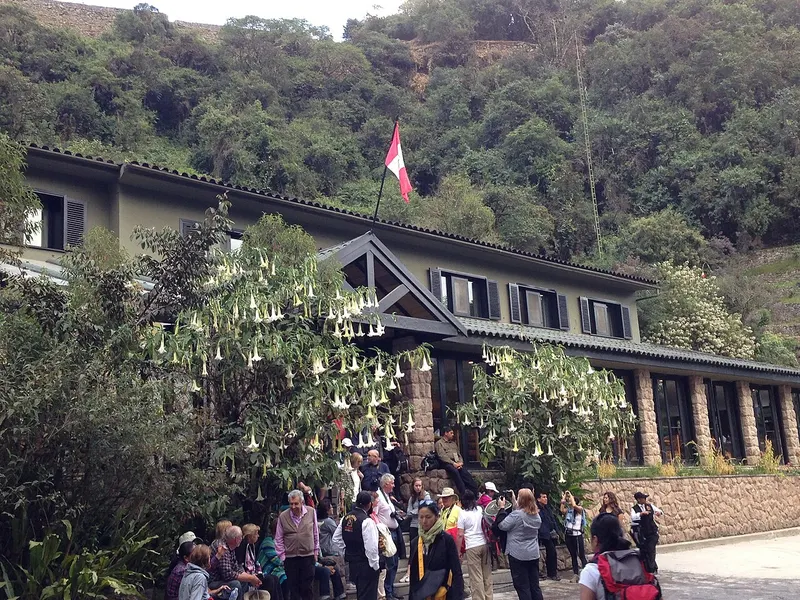
The rarest luxury at Machu Picchu is location. The Belmond Sanctuary Lodge is the only hotel at the citadel gate itself — everyone else sleeps down in Aguas Calientes and rides the bus up. Staying at the lodge means you can be among the very first through the gate at dawn, before the day's trains have even reached the valley, walking a near-empty citadel with your private guide as the cloud lifts off the terraces. For the traveller who wants the postcard view without the crowds, this is the single most valuable splurge of the entire trip — worth far more than any in-room indulgence.
If the lodge is full or beyond budget, the best hotels in Aguas Calientes are the strong alternative: a riverside retreat or a cloud-forest hideaway with its own orchid gardens and spa, from which the early bus still gets you up ahead of most. Whichever you choose, the strategy is the same — sleep as close to the gate as you can, take the earliest entry your ticket allows, and let a private guide turn the morning from a scramble into a slow, knowledgeable unveiling.

The citadel morning, done in style
At the gate your timed-entry ticket sends you onto your chosen circuit, and the luxury difference is your private guide. Rather than shuffling in a group, you move at your own pace while a licensed expert reads the citadel for you — the engineering of the terraces, the astronomy of the carved Intihuatana, the precision masonry of the Temple of the Sun — and steers you to the overlook at the moment the light is best and the crowds are thinnest. A good private guide is the difference between seeing Machu Picchu and understanding it.
If you have booked an add-on peak, Huayna Picchu or Machu Picchu Mountain, your guide will pace the morning around its separate entry window. Otherwise, take the circuit slowly, linger at the great viewpoints, and let the place work on you. When you are ready, the bus carries you back down to your lodge or the train, with nothing to rush for and nothing to organise — which is, in the end, exactly what the luxury was for.


Pacing, add-ons and one true luxury: time
The mistake even well-funded trips make is to compress the schedule because they can afford to move fast. Resist it. The greatest luxury on a Machu Picchu trip is an unhurried calendar: extra nights at the best lodges, a second visit to the citadel on a different circuit if it moved you, a free day for a private excursion to a high lake or a hands-on cooking class, and never a same-day connection to an international flight. Spend your money on time and on lower-altitude, longer stays, and the trip rewards you twice over — in comfort and in how your body copes.
Beyond the core, a luxury itinerary has room for the indulgences a standard one skips: a private culinary evening in Cusco, a spa afternoon in the valley, a helicopter or first-class onward leg, an astronomy night at a valley lodge. Add these once the spine — ticket, train, hotels — is locked, never before. And keep the volatile details to the properties and operators: prices, schedules, circuit rules and the hotel particulars all move, while the shape of a slow, soft, beautifully-paced luxury week stays the same.
- Buy time, not speed: extra nights, longer lodge stays, no same-day international connection.
- Sleep lower and longer to make the altitude effortless.
- Add private excursions, spa days and culinary evenings only after the ticket-train-hotel spine is set.
- Use a private guide and driver throughout — the ease is the point.
- Verify current prices, train schedules, circuits and hotel details directly — this guide stays evergreen.


Related guides

Luxury hotels in Cusco
Cusco's grandest stays — the converted palaces and monasteries, oxygen-supported rooms, spa retreats and special-occasion bases that make the high capital a romance in its own right before Machu Picchu.
Read guide
Luxury Sacred Valley Hotels
The Sacred Valley's high-end lodges, spa retreats and honeymoon bases — destination hotels where pampering doubles as low-altitude acclimatization before Machu Picchu.
Read guide
Hiram Bingham Luxury Train
A decision guide to the route's only luxury train — a Belmond Pullman-style service for honeymoons and milestones, with its inclusions, ticket caveats and routing.
Read guideMore in Itineraries
6
A Machu Picchu Honeymoon
How to build a honeymoon around Machu Picchu — romantic hotels in Cusco and the Sacred Valley, a luxury train into the gorge, a private guide, spa days and a dawn at the citadel.
Read guide
Beyond the Citadel: Peru Add-Ons to Machu Picchu
How to bolt the rest of Peru onto a Machu Picchu trip — Rainbow Mountain, Humantay Lake, the South Valley and the bigger leaps to the Amazon, Lake Titicaca, Lima and Arequipa — sequenced for altitude and time.
Read guide
Family Machu Picchu Itinerary: A Kid-Paced Plan
A family-paced Machu Picchu itinerary built around the altitude ladder, kid-friendly circuits, the train, Sacred Valley downtime and unhurried buffer days — so children and grandparents arrive at the citadel rested, not wrecked.
Read guide
Five Days: Cusco, the Sacred Valley & Machu Picchu
A balanced five-day Machu Picchu itinerary — proper Cusco acclimatization, an unhurried Sacred Valley, an overnight in Aguas Calientes and the citadel, with altitude and ticket buffers built in so a cloudy morning or a late train never sinks the trip.
Read guide
Machu Picchu by Train: A Step-by-Step Itinerary
A train-based Machu Picchu itinerary from Cusco or Ollantaytambo — the booking order, hotel timing, the bus up from Aguas Calientes, and the backups that keep the day calm.
Read guide
Machu Picchu Couples Itinerary: A Slow, Romantic Route
A romantic Machu Picchu itinerary for two: a luxury Sacred Valley base, the panoramic train, a private guide, the quietest entry slot for that first hush at the overlook, and long candlelit meals that turn a bucket-list trip into a love story.
Read guide