
Luggage Storage in Cusco & Aguas Calientes
Where to leave the big bag for the citadel — hotel storage in Cusco and Ollantaytambo, the train baggage limit that forces the issue, station storage in Aguas Calientes, the trek-duffel system, and how to stage it all cleanly.

Photo: Darya Luganskaya / Unsplash
- ✓The trains to Aguas Calientes enforce a strict per-person baggage limit, so the big suitcase cannot come down the line — it has to wait somewhere.
- ✓Your Cusco hotel is the standard, almost-universal answer: hotels here routinely store guest luggage free between nights while you're at the citadel.
- ✓If you stage in the Sacred Valley, your Ollantaytambo hotel plays the same role, right beside the train.
- ✓Aguas Calientes hotels hold bags either side of check-in, and storage exists near the station — but everything bigger than a small bag should never have left Cusco.
Why you have to leave a bag behind at all
Almost every Machu Picchu trip arrives at the same small logistical puzzle: you've flown into Cusco with a proper suitcase, and now you need to reach a cloud-forest citadel that your suitcase physically cannot follow you to. This isn't a quirk — it's structural. The only ways into the gorge are the train and the treks, and both impose firm limits on what you can bring. The train enforces a strict per-person baggage allowance (broadly a daypack plus one small bag, within set size and weight limits), and the citadel gate restricts large bags on top of that. The big bag, simply, stays behind.
So the real question of this page isn't whether to leave luggage — it's where, and how to stage it so you never find yourself dragging a wheeled case somewhere it shouldn't be. The good news is that the answer is well-worn and easy: Cusco's entire hospitality industry is built around travellers leaving a bag while they spend a night or two at the mountain. Storage here is a standard, expected, usually free service, not a favour you have to negotiate. Get the staging right once and the whole trip flows.
There's a mindset shift in it, too. The constraint that feels like an inconvenience on day one becomes a genuine relief by the time you're climbing Inca stairs in thin air with only a daypack on your shoulders. Nobody who's done it wishes they'd brought the big bag up the mountain.


Cusco hotels: the standard place to leave the big bag
For the great majority of travellers, the answer is the simplest one: leave the main suitcase at your Cusco hotel. Hotels, guesthouses and hostels across the city offer free luggage storage for guests as a matter of course — you check out (or leave before check-in), hand over the bag, take a tag or a note of the room, and collect it when you return from the citadel a night or two later. Because almost everyone here is doing exactly this, the system is smooth and the staff are used to it.
The natural rhythm looks like this. You spend your first nights in Cusco acclimatizing; on the morning you leave for the mountain, you store the big bag at the hotel where you'll sleep again on your return, pack a small bag for one or two nights, and head for the train. When you come back down, you collect the suitcase and carry on. The key detail is to store it where you'll actually sleep on the return night, so collection is effortless — many people book the same Cusco hotel either side of the citadel precisely for this reason.
A few sensible cautions. Confirm storage with your specific property when booking rather than assuming, since arrangements vary at the margins; ask whether the room is locked and supervised if you're storing anything of value; and never leave passports, electronics, medication or anything irreplaceable in a stored bag — those travel with you in the daypack. If your hotel can't store it for some reason, there are dedicated left-luggage services and agencies around the centre and near the main squares, but the hotel route is so standard you'll rarely need them.
- Cusco hotels and hostels almost universally store guest luggage free — the standard, expected move.
- Store the bag where you'll sleep on your return night; many people book the same Cusco hotel either side for easy pickup.
- Confirm storage with your specific property on booking; ask if the room is locked and supervised for valuables.
- Keep passport, electronics, medication and anything irreplaceable on you — never in a stored bag.
- Dedicated left-luggage agencies exist near the centre as a backup, but the hotel route usually does the job.


Staging in the Sacred Valley: Ollantaytambo storage
Not everyone runs the trip out of Cusco. Many travellers — especially those who want a gentler altitude start or an earlier train — spend the night before the citadel in the Sacred Valley, usually in Ollantaytambo, where the rail line to Aguas Calientes begins. If that's you, your Ollantaytambo hotel plays exactly the same storage role as a Cusco one: leave the big bag there, take a small bag on the train, and collect the suitcase when you pass back through.
This can actually be the cleaner stage. Ollantaytambo's train platform is a short walk from its hotels, so storing the bag and walking to the train is about as frictionless as the trip gets, and you avoid hauling luggage down from Cusco only to store it again. The decision follows your sleeping plan: if your return night is in Cusco, store there; if it's in the valley, store in Ollantaytambo. Some travellers split the difference — big bag in Cusco, an overnight bag in Ollantaytambo — but that's usually over-engineering a simple thing.
As always, confirm the arrangement with your specific Ollantaytambo property, since the valley's lodgings range from tiny guesthouses to larger hotels and not all handle storage identically. And keep the same self-discipline about valuables: passport and tickets ride with you, because they're name-checked at the citadel gate and you do not want them sitting in a duffel a valley away.
- Staging in Ollantaytambo? Your hotel there stores the big bag just as a Cusco one would — and the train platform is a short walk.
- Store where your return night is: Cusco if you sleep there on the way back, Ollantaytambo if in the valley.
- Confirm storage with the specific valley property — lodgings range from tiny guesthouses to larger hotels.
- Passport and tickets always travel with you; they're checked at the gate.


Aguas Calientes and the citadel gate
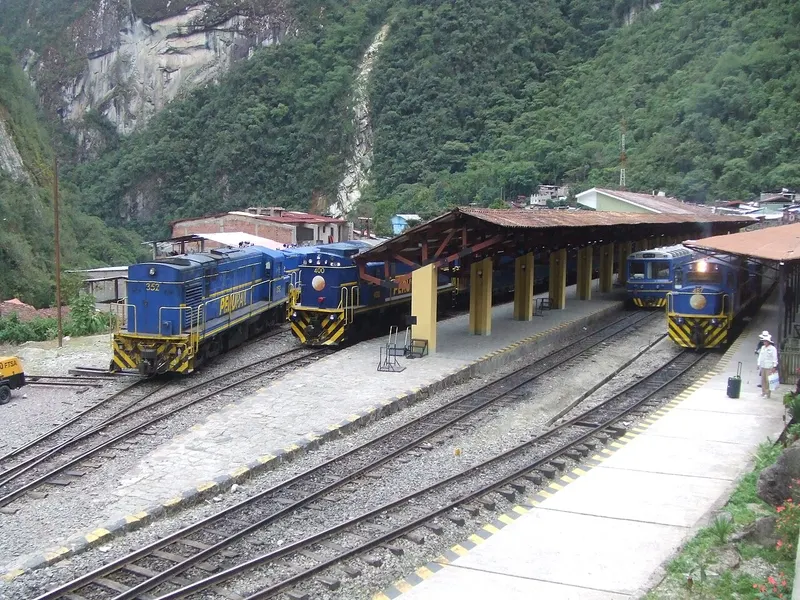
Once you're down in Aguas Calientes — the small town at the foot of the mountain — you still have a small bag to manage on the day you visit the citadel. Your hotel here will hold it for you either side of check-in and check-out: drop it on arrival before your room is ready, or leave it after you've checked out on the morning of your train back. There's also luggage storage near the station for travellers between trains who aren't staying the night. So even at this end of the line, a bag is easy to set down.
The citadel itself applies one more limit. Large backpacks and suitcases are restricted at the entrance — the working rule is a small daypack only inside the site — and there is luggage storage at the gate for anything that doesn't make the cut. In practice, if you've followed the plan, you'll only ever have a daypack with you on the mountain, so the gate storage is a backstop rather than something you need. The day flows as: arrive in Aguas Calientes, set the small bag down at your hotel or station storage, carry only a daypack up to the citadel, and reclaim everything before the train out.
Sizes, fees and exact rules at both the station and the gate change over time, so treat the specifics as something to verify on the day rather than memorise in advance. The principle, though, is stable: the only thing that should reach the citadel is a daypack, and everywhere along the chain there's a place to leave the rest.
- Aguas Calientes hotels hold your bag before check-in and after check-out; station-area storage exists for those between trains.
- The citadel restricts large bags at the gate — a small daypack only inside — with storage at the entrance as a backstop.
- If you've packed right, you'll only carry a daypack up, so gate storage is rarely needed.
- Station and gate fees, sizes and rules change — verify the current specifics on the day.
Trekkers: the porter-and-duffel system
If you're walking in on the Inca Trail, Salkantay or Lares rather than taking the train, luggage works on a different model again — and the storage logic still holds at its core. Organised treks use a porter-carried duffel with a weight allowance set by the operator: you pack the essentials for the walk into that duffel, carry your own daypack each day with water, layers and the day's needs, and everything beyond the trek stays behind in storage in Cusco, exactly as a train traveller's suitcase does.
The discipline here is to pack the trek duffel to the operator's limit, not your optimism — the allowance is firm and the duffel is weighed, because a porter is the one carrying it at altitude. Anything that isn't needed on the trail goes into your Cusco hotel's storage to be collected when you return. Many trekkers book a Cusco hotel for the nights either side of the walk for exactly this continuity: store the big bag on the way out, reclaim it (and a hot shower) on the way back.
Because allowances, what's provided, and the storage arrangements are all operator-specific, confirm the details with yours before you pack. But the instinct is universal across every way of reaching Machu Picchu, train or trail: the less that comes up the mountain, the better the trip — and there is always somewhere safe to leave the rest.
- Treks supply a porter-carried duffel with a set weight allowance — pack to that firm limit, since a porter carries it.
- You still carry your own daypack daily; everything non-essential stays in Cusco storage.
- Book a Cusco hotel either side of the trek to store the big bag and reclaim it (and a shower) on return.
- Allowances and storage details are operator-specific — confirm yours before packing.

At a glance — staging your luggage
The storage plan in one place. Fees, sizes and exact rules change, so verify the specifics when you book and on the day.
- The big suitcase never reaches the mountain — the train limit and citadel gate both forbid it.
- Default move: store it free at your Cusco hotel, where you'll sleep again on return.
- Staging in the valley: store at your Ollantaytambo hotel instead, a short walk from the train.
- Aguas Calientes hotels hold your small bag either side of check-in; station storage covers those between trains.
- Inside the citadel: daypack only; gate storage is a backstop for oversized bags.
- Trekkers: pack a porter duffel to the operator's limit and leave everything else in Cusco.
- Always: passport, tickets, electronics and medication stay on you — never in a stored bag.


Related guides

Luggage Rules & Storage for Machu Picchu
Train baggage limits, where to leave the big bag in Cusco or Ollantaytambo, what to carry into the citadel, station storage in Aguas Calientes, and the trek-duffel system.
Read guide
Cusco to Machu Picchu: Every Way to Make the Journey
The realistic ways from the old capital to the citadel — train, bimodal bus-and-train, staging in the Sacred Valley, the long Hidroeléctrica back door, and whether a one-day round trip is sane.
Read guide
Where to stay in Aguas Calientes
How to choose a base in the little town below Machu Picchu — weighed not on stars but on how cleanly it gets you onto the first bus, off a late train, fed early, and settled for an altitude-friendly night before the citadel.
Read guideMore in Best time to visit
6
Accessible Machu Picchu
An honest look at mobility at the citadel — the uneven Inca stone, the stairs, how the train and shuttle bus help, hotel strategy, the gentlest circuit and route, and why a private guide is the key to a workable visit.
Read guide
Altitude & When to Go: The When-to-Visit Hub
The home for timing your trip — the two Andean seasons, altitude and acclimatization, dry- versus rainy-season trade-offs, and the month-by-month guides that tell you what each part of the year really means at the citadel.
Read guide
Altitude in Machu Picchu, Cusco & the Valley
How altitude really works across the trip — why Cusco is higher than the citadel, where soroche hits hardest, the low-to-high-to-low ladder, and sensible pacing, with medical-caution language throughout.
Read guide
Hiking & Site Safety at Machu Picchu
Staying safe on the steep, slick, exposed parts of the visit — the citadel's stone stairs, wet-weather footing, altitude on the climbs, and the demanding mountain ascents of Huayna Picchu and Machu Picchu Mountain.
Read guide
Inti Raymi in Cusco
Cusco's Festival of the Sun on 24 June — the great Inca winter-solstice pageant at Sacsayhuamán, and how to plan Machu Picchu around the busiest, brightest week of the year.
Read guide
Is Machu Picchu Safe?
An honest safety picture for the whole trip — trains and buses, the treks, altitude, petty theft and money, occasional strikes and weather disruption, crowds, and travelling solo or as a woman.
Read guide