
The Temple of the Condor: Reading the Bird in Stone
The carved condor in the lower urban sector — how natural rock and worked stone form the bird, the chambers and niches behind it, the debate over its use, and which circuit reaches it.
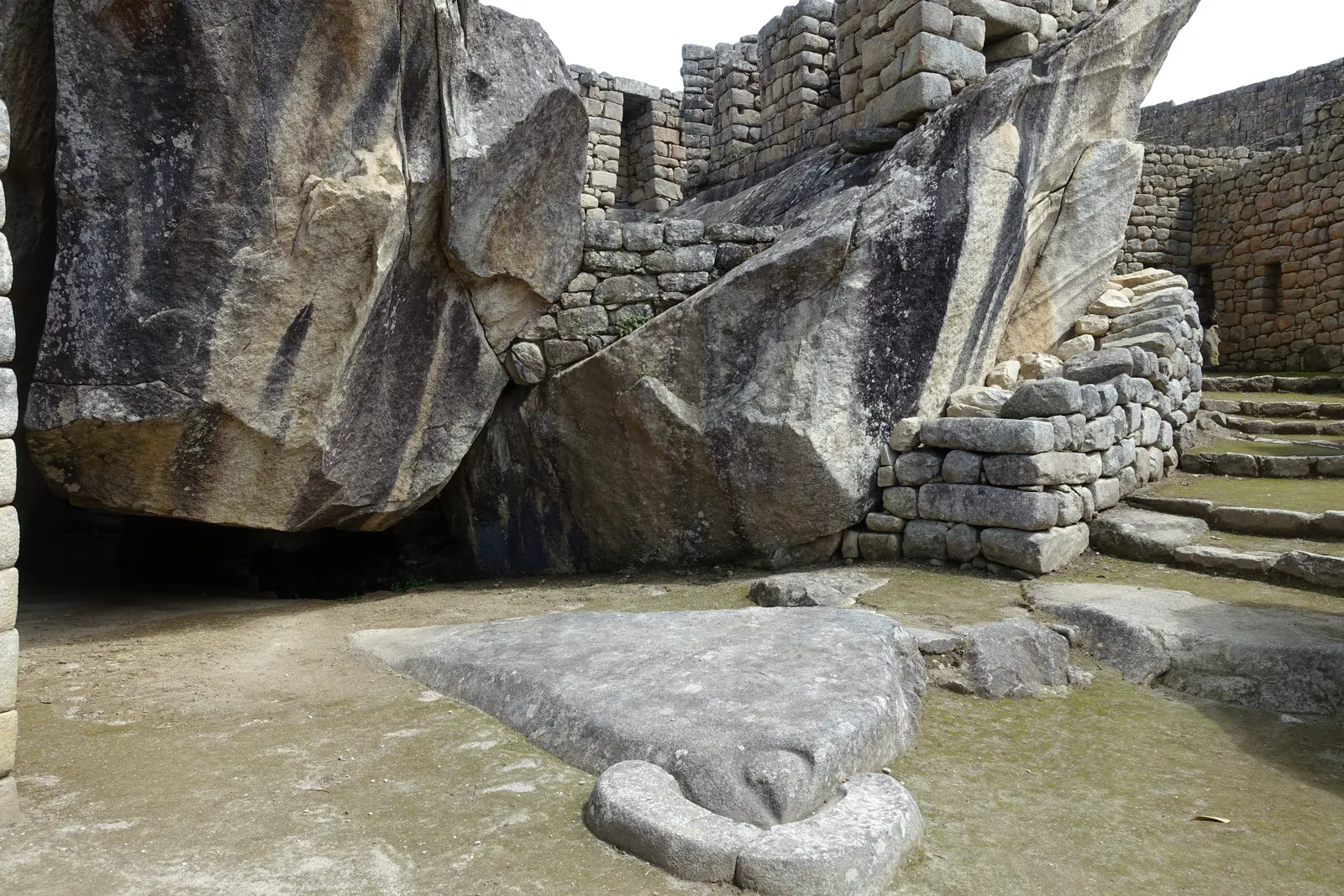
Photo: Ellywa / Wikimedia Commons · CC BY-SA 4.0
- ✓The Temple of the Condor uses two great natural rock outcrops as the spread wings of a condor, with a carved stone on the floor forming the bird's head and white neck-ruff.
- ✓It is a masterclass in the Inca habit of working with the landscape — completing a natural form with a little precise carving rather than imposing on it.
- ✓Behind it lie chambers, niches and a stone often read as an altar; its exact use is debated — temple, ritual space, even a possible prison are all proposed.
- ✓It sits in the lower urban sector and is reached on the lower/royal routing — verify your circuit and route include it before booking.
A condor carved from the mountain
In the lower urban sector of Machu Picchu, two huge natural rock outcrops rise and splay apart, angled upward like a pair of wings. On the floor between them lies a flat carved stone, shaped and lightly worked into the form of a bird's head with a pale, ruffed collar — the white neck-feathers of the Andean condor, the great soaring vulture of the high Andes. Step back, let your eye assemble the pieces, and the whole tableau resolves into an enormous condor in the moment of landing, wings raised, head bowed to the ground.
It is one of the most quietly astonishing things at the site, because so little of it is built. The Inca did not carve a condor out of nothing; they found two outcrops that already looked like wings and added the single stone that turned suggestion into image. That restraint is the signature of Inca sacred architecture — the conviction that the mountain itself was alive and divine, and that the mason's job was to reveal a form already latent in the rock, not to override it. Here that philosophy produces a temple you read rather than simply look at.
What lies behind the bird
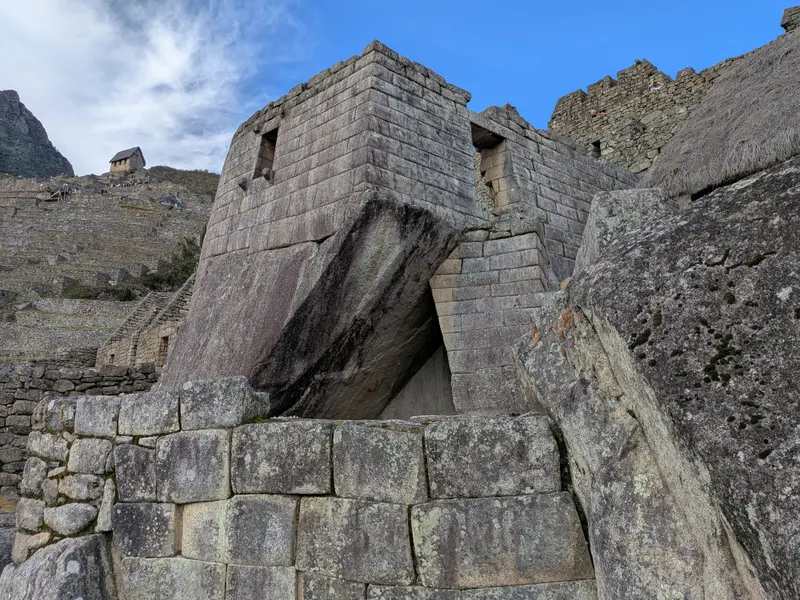
The condor is the face of the temple, but there is more behind it. Tucked beneath and around the outcrops are small chambers, niches and worked surfaces, including a stone that many guides describe as an altar set just behind the condor's head. The trapezoidal niches in the rock here are of the careful, fitted kind the Inca reserved for places that mattered, and the whole complex has the inward, shadowed feel of a ritual space rather than a dwelling.
What actually happened here is debated. The dominant reading is ceremonial — a temple to the condor, which in Andean belief carried the souls of the dead skyward and linked the world of the living to the upper realm of the heavens. Some early interpreters, struck by small recesses in the rock, proposed darker uses such as a prison or a place of sacrifice, but those readings are speculative and much disputed. As with so much at Machu Picchu, the Inca left no text, so treat the confident stories you hear as leading theories rather than fact. What is not in doubt is the symbolism: the condor was one of the three sacred Andean animals, alongside the puma and the snake, and to carve one at the heart of the city was a deliberate statement.
- Behind the bird: chambers, fitted niches and a stone often described as an altar.
- Dominant reading: a ceremonial temple to the condor, messenger between the living and the heavens.
- Older 'prison' or 'sacrifice' theories are speculative and disputed — leading guesses, not proven fact.
- The condor was one of the three sacred Andean animals — puma, snake and condor.
Which circuit reaches it
The Temple of the Condor sits low in the urban sector, and under the timed-entry circuit system reorganised by Peru's Ministry of Culture in 2024, you reach it on a circuit and route that descends into that part of the citadel — broadly the lower, royal routing, the same side of the sanctuary that carries the Temple of the Sun and the Huayna Picchu and Machu Picchu Mountain add-on climbs. The upper, panoramic routing that delivers the classic Guardhouse overlook generally does not bring you down to the Condor.
Because the circuits are largely one-way and fixed when you buy the ticket, this is a choice to make in advance, not at the gate. A visitor who wants the Condor and the Temple of the Sun takes a lower circuit; one who wants the postcard overlook takes an upper one — and a single ticket rarely delivers both in full. Decide which side of the sanctuary matters more to you, confirm the current routing at the point of sale, and bear in mind the official circuit definitions have been revised before and may change again. Verify.
- The Temple of the Condor sits in the lower urban sector — reached on the lower/royal routing.
- That is the same side as the Temple of the Sun and the peak climbs.
- The upper/panoramic routing gives the overlook but usually not the descent to the Condor — one ticket rarely gives both.
- Routes are largely one-way and fixed at purchase; confirm current routing — verify.

Seeing it well
The trick with the Temple of the Condor is to look twice. On first pass, walking the lower circuit, it can read as just another cluster of rock and wall — easy to hurry past without registering the bird at all. Stop, find the angle from which the two outcrops become wings and the floor stone becomes the head, and the whole image snaps into focus. Many visitors miss the condor entirely simply because they never paused to let their eye assemble it; a moment of patience is the difference between a pile of stones and a temple.
This is another place where a guide pays for itself. The condor is not labelled, the symbolism is not obvious, and the debate over the chambers behind it is exactly the kind of context that turns a glance into an understanding. Since Peru's rules already steer many visitors toward guided entry, the Temple of the Condor is a good reason to go in with someone who can point out the wings, the ruff and the altar, and explain why a soaring vulture sat at the spiritual heart of the city. Light here is gentler than at the sun temples — the chambers are shadowed — so it reads well through much of the day.
- Look twice: find the angle where the outcrops become wings and the floor stone becomes the head.
- Many visitors miss the condor entirely by not pausing — patience is the whole trick.
- A guide adds real value; the bird is unlabelled and the symbolism is not obvious.
- Shadowed chambers mean it reads well through much of the day, not only at dawn.

At a glance
A quick reference before you choose the circuit that reaches it. Exact routing, capacities and rules change with official policy — treat what you find on official sources as current and verify before booking.
- What it is: a condor formed from two natural outcrops (the wings) and a carved floor stone (the head and neck-ruff).
- Behind it: chambers, fitted niches and a stone often read as an altar.
- Function: most likely a ceremonial temple to the condor; 'prison' theories are disputed and unproven.
- Access: the lower/royal routing through the urban sector — verify your circuit and route include it.
- Seeing it: find the angle that assembles the bird; easy to walk past unnoticed.
- Who it suits: anyone interested in Inca symbolism and the art of carving with the landscape — best with a guide.
The bird at the heart of the city
The Temple of the Condor is Machu Picchu's clearest lesson in how the Inca saw the world: not as raw material to be conquered, but as a living landscape already full of sacred forms waiting to be revealed. With two outcrops and a single carved stone, they made the great messenger-bird of the Andes appear at the centre of their mountain city — wings spread, head bowed, forever caught in the act of landing. It is subtle, strange and, once you have seen it, impossible to unsee.
Just be sure your ticket takes you there. The Condor lives on the lower side of the sanctuary, and the route that reaches it is locked when you book. If the carved bird is on your list, choose a lower circuit, slow down enough to let the image resolve, and ideally bring a guide who can read the temple for you — wings, ruff, altar and all.
Related guides

Circuit 3 Royalty guide
The lower 'Royalty' circuit that hugs the citadel's urban core — the gateway to Huayna Picchu, Huchuy Picchu and the Great Cavern, and the path most Inca Trail walkers finish on.
Read guide
Machu Picchu Site Guide: Circuit by Circuit
How to read and walk the citadel under the post-2024 system — the three circuits, the landmarks each one reaches, the photo points, the order you move, and how to pace a one-way visit at altitude.
Read guide
Machu Picchu Highlights: What You'll See
The set pieces inside the citadel — the Guardhouse overlook, the Temple of the Sun, the Intihuatana, the Sacred Rock, the Sun Gate and the Inca Bridge — and which circuit and route reaches each one.
Read guideMore in Highlights
6
A Rainy Day at Machu Picchu
Rain at the citadel is normal, not a disaster — how to dress for cloud forest, which circuits cope best, how to build train buffers, the Aguas Calientes backups, and why mist makes the most haunting photographs of all.
Read guide
Aguas Calientes (Machu Picchu Pueblo): The Complete Guide
Aguas Calientes — officially Machu Picchu Pueblo — the cloud-forest town at the foot of the citadel. Where to sleep, how the trains and buses connect, the food, the hot springs, luggage, and how long to stay for a calmer entry.
Read guide
Around the Site: Machu Picchu Up Close
The hub for the world immediately around the citadel — what to see inside it, the town of Aguas Calientes below, where to stay, the first buses up, the hot springs, the restaurants, and how to visit responsibly.
Read guide
Best Photography Spots at Machu Picchu
Where the great Machu Picchu photographs are actually made — the classic upper-terrace frame, the llamas, the morning cloud, and which circuit reaches each angle. Plus the sunrise myth and what you simply cannot access.
Read guide
Budget hotels for Machu Picchu
Better-value places to sleep along the Machu Picchu route — honest guesthouses and well-run hostels in Cusco, Ollantaytambo and Aguas Calientes — chosen to stretch the trip without wrecking the altitude ladder or the citadel-morning logistics.
Read guide
Luxury hotels for Machu Picchu
The top-end stays that string together a polished Machu Picchu journey — restored monasteries and oxygen-equipped suites in Cusco, hacienda-and-spa retreats in the Sacred Valley, and the one true luxury option at the gate of the citadel itself.
Read guide