
The South Valley (Valle Sur) of Cusco
Cusco's quieter southern valley — the water terraces of Tipón, the vast Wari city of Pikillaqta and the painted Sistine-of-the-Andes church at Andahuaylillas — a low-altitude, low-crowd day covered by the Boleto Turístico.

Photo: Ruben Hanssen / Unsplash
- ✓The South Valley (Valle Sur) is the low-altitude, low-crowd alternative to the busy northern Sacred Valley — a calm day of ruins and a remarkable church.
- ✓Its three set pieces: Tipón's Inca water terraces, the huge pre-Inca Wari city of Pikillaqta, and the gilded Andahuaylillas church, the 'Sistine Chapel of the Andes'.
- ✓Tipón and Pikillaqta are covered by the Cusco Boleto Turístico; Andahuaylillas church charges separately — verify current details when you go.
- ✓Lower and gentler than the high day trips, it's a fine choice while you're still acclimatizing, or as a slow day after the citadel.
The valley most visitors miss
Almost everyone who comes to Cusco pours north and west into the famous Sacred Valley — Písac, Ollantaytambo, Maras and Moray — on the way to Machu Picchu. Far fewer turn south-east, down the valley of the Río Vilcanota toward Tipón and Urcos, and that's exactly the South Valley's charm. Valle Sur is quieter, lower, and less polished for tourism, a day of genuine depth without the crowds: Inca hydraulic engineering, a sprawling pre-Inca city, and one of the most extraordinary colonial church interiors in the Americas, all within a short drive of the city.
It's the contrarian add-on. Where Rainbow Mountain and Humantay Lake ask for thin-air endurance and an iconic photo, the South Valley offers a calm, low-altitude day for travellers who want history and atmosphere over altitude and crowds — ideal early in a trip while you're still adjusting, or as a gentle wind-down after the citadel.
At a glance
The shape of the day before you commit. The route is stable; opening hours, ticket coverage, prices and tour timings shift, so verify those directly when you go.
- Where: south-east of Cusco down the Vilcanota valley — Tipón, Pikillaqta and Andahuaylillas.
- Altitude: high (these sit roughly around Cusco's level) but with little hard climbing — far gentler than the high day trips.
- Day length: a comfortable half- to full-day loop; an easy day out from Cusco.
- Tickets: Tipón and Pikillaqta are covered by the Boleto Turístico; Andahuaylillas church charges separately.
- Effort: light walking at the sites — no extreme-altitude hiking.
- Why come: low crowds, real depth (Inca + Wari + colonial), and a beautiful painted church.
- Note: hours, ticket rules and prices change — verify before you go.
Tipón — the Inca's masterwork in water
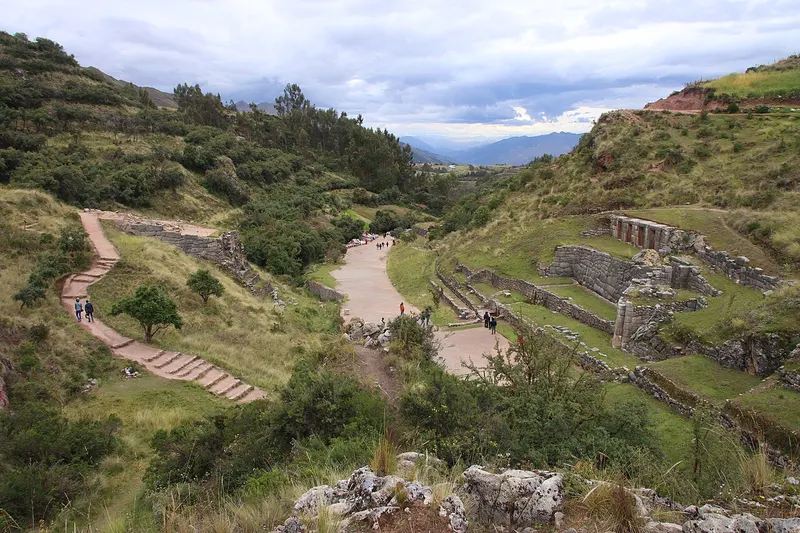
Tipón is the South Valley's quiet showstopper: a series of broad Inca terraces threaded with stone channels and fountains where water still runs, centuries on, exactly as its builders intended. It's widely read as a ceremonial and agricultural site dedicated to water — a demonstration of the Inca genius for hydraulics, with channels carved so precisely that springs feed fountains and irrigate terraces in an unbroken, deliberate flow. Standing among the running water on a sunny highland day, with the channels glinting down the terraces, is one of the most serene experiences near Cusco.
It sits above the valley floor, so reaching the upper terraces means a gentle uphill walk, but nothing like the high-altitude climbs of Rainbow Mountain or Humantay. Tipón is covered by the Boleto Turístico, the combined Cusco tourist ticket, so if you already hold one for the city and Sacred Valley sites, your visit here may already be paid for — verify current coverage when you go.
Pikillaqta — a city older than the Inca
A short drive on lies Pikillaqta, and it tells a story most Cusco itineraries never reach: the Andes before the Inca. Pikillaqta was a major city of the Wari, the highland empire that flourished centuries before the Inca rose, and its scale is startling — a vast grid of geometric streets, plazas, storehouses and high-walled compounds spread across the plain, built to a rigid plan that speaks of a powerful, organized state. Walking its quiet, ruined avenues, you sense an entire civilization that predates the masonry you'll meet at Machu Picchu.
It's a flat, easy site to walk, which makes it a relaxed counterpoint to Tipón's terraces, and it's also covered by the Boleto Turístico. Nearby, the old gateway of Rumicolca — a great stone wall the Inca later rebuilt over Wari foundations, controlling the route into the Cusco valley — adds another layer to the day, a literal threshold between empires.
Andahuaylillas — the Sistine Chapel of the Andes
The day's surprise climax is a modest village church with an interior that stops people in their tracks. The 17th-century church of San Pedro Apóstol in Andahuaylillas, plain and adobe from the outside, is lavishly painted within — every wall, beam and ceiling covered in murals, gilding and frescoes — which has earned it the nickname the 'Sistine Chapel of the Andes'. It's a vivid record of colonial Andean Catholicism, where European Baroque met local hands and pigments, and one of the most beautiful church interiors in Peru.
Unlike the ruins, the church is not part of the Boleto Turístico and typically charges its own admission, so carry cash and check current hours — village churches keep their own schedules and may close over lunch or for services. Photography rules inside can be restricted to protect the murals; respect any signs. Set against Tipón's water and Pikillaqta's stone, Andahuaylillas closes the day with colour, gold and a different century.
- A plain adobe exterior hiding a lavishly painted Baroque interior.
- Charged separately from the Boleto Turístico — bring cash and check hours.
- Hours can be limited and may close over lunch or for services — verify locally.
- Photography may be restricted inside to protect the murals — follow the signs.

Tickets: the Boleto Turístico and what it covers
The South Valley is a good reason to understand the Boleto Turístico, Cusco's combined tourist ticket. It bundles entry to a set of sites across the city, the Sacred Valley and the South Valley — Tipón and Pikillaqta among them — on a single multi-day pass, rather than charging at each gate. If you're already buying one for Cusco's ruins and the northern valley, the South Valley sites may be covered, which makes adding this day cheaper than it first looks.
There are different versions of the ticket (full and partial circuits), and exactly which sites each covers, how long it's valid, and what it costs can change, so check current details rather than assume. Crucially, the Boleto Turístico does not cover the Andahuaylillas church, which charges separately, nor does it cover Machu Picchu, which runs on its own entirely separate timed-entry ticket. Keep those three ticketing systems straight and you'll avoid surprises at the gate.
- The Boleto Turístico covers Tipón and Pikillaqta among many Cusco-area sites.
- Different ticket versions cover different sites for different validity periods — verify current details.
- Andahuaylillas church is separate and charges its own admission.
- Machu Picchu is entirely separate, on its own timed-entry ticket — don't confuse the systems.
How to do the South Valley, and food along the way
You can do the South Valley as an organized half- or full-day tour, with a private driver, or independently by hired car or colectivo down the Vilcanota road — it's close enough to Cusco that none of these is a major undertaking. A guide adds useful context at Pikillaqta and Andahuaylillas, where the history isn't self-explanatory; independent travel buys you time to linger at Tipón's fountains or over lunch.
And lunch is part of the draw. The South Valley, and the town of Tipón in particular, is famous across the region for cuy — roast guinea pig, the traditional Andean celebration dish — with a strip of restaurants known for it. It's an acquired taste and a genuinely local one; if it's not for you, the same kitchens serve other Andean fare. Either way, a long highland lunch fits the unhurried spirit of the day far better than the grab-and-go pace of the high mountain trips.
- Visit by organized tour, private driver, or independently by car or colectivo — all easy from Cusco.
- A guide helps at Pikillaqta and the church; independent travel buys lingering time.
- Tipón is renowned regionally for cuy (roast guinea pig); other Andean dishes are available too.
- Keep it unhurried — the South Valley rewards a slow lunch and a calm pace.
When the South Valley beats a crowded route
The South Valley wins on the days when crowds and altitude are working against you. It's the right call early in a trip, while you're still acclimatizing and a 5,000 m mountain would be reckless — light walking at moderate height that lets you sightsee gently while your body adjusts. It's also a fine slow day after Machu Picchu, when you've spent your energy on the citadel and want depth without another pre-dawn endurance morning. And it's a relief any time the northern Sacred Valley feels too busy: here you'll often have whole sites nearly to yourself.
It won't suit everyone. If you've travelled all this way for the iconic high-Andes photo, a rainbow ridge or a turquoise lake will speak louder than terraces and a painted ceiling. But for travellers who value history, calm and a low-effort day — or who simply need a gentle slot in a trip that's otherwise all altitude and crowds — the South Valley is one of the most rewarding and underrated days near Cusco. Match it to the day you have, and it more than earns its place.


Related guides
Boleto Turístico del Cusco
How the COSITUC Boleto Turístico works — the combined pass that covers Sacsayhuamán, Pisac, Ollantaytambo, Moray, the Maras–style sites and a clutch of Cusco museums — and when it's actually worth buying.
Read guide
Beyond the Citadel: Peru Add-Ons to Machu Picchu
How to bolt the rest of Peru onto a Machu Picchu trip — Rainbow Mountain, Humantay Lake, the South Valley and the bigger leaps to the Amazon, Lake Titicaca, Lima and Arequipa — sequenced for altitude and time.
Read guide
Cusco: Your Base for Machu Picchu
The old Inca capital at 3,399 m is where every Machu Picchu trip begins — where to stay, how to acclimatize, what to see on a gentle first day, and how to stage the train down to the citadel.
Read guideMore in Peru add-ons
6
Arequipa & Colca After Machu Picchu
How to add the white city of Arequipa and the condors of Colca Canyon to a Machu Picchu trip — the altitude twist, the transport between Cusco, Puno and the south, and whether you have the days for it.
Read guide
Humantay Lake from Cusco
A practical day-trip guide to Laguna Humantay — the early start, the short but steep high-altitude hike, the turquoise glacial lake, its Salkantay context, and who should think twice.
Read guide
Lake Titicaca After Machu Picchu
How to add the highest navigable lake in the world to a Machu Picchu trip — the train, bus and flight options between Cusco and Puno, the islands worth your time, and altitude-aware pacing.
Read guide
Lima Before Machu Picchu
Where Peru's capital fits in a Machu Picchu trip — using a sea-level night to beat jet lag, eat exceptionally well, and break the climb to Cusco's altitude in two.
Read guide
Palcoyo vs Vinicunca: Which Rainbow Mountain?
How to choose between Palcoyo and Vinicunca (Rainbow Mountain) — compared on altitude, crowds, effort, photos, road time and weather, so you pick the right rainbow ridge for your body and your day.
Read guide
Q'eswachaka: The Last Inca Rope Bridge
The last living Inca rope bridge, rewoven from grass every June above the Apurímac gorge — what it is, how to reach it from Cusco, and who should make the long day trip.
Read guide