
Dead Woman's Pass: The Inca Trail's Hardest Day
Warmihuañusca — the 4,215 m high point of the classic Inca Trail and the day everyone fears. The altitude, the effort, the pacing, the weather and the mental game of the trek's toughest climb.

- ✓Dead Woman's Pass — Warmihuañusca in Quechua — is the highest point of the classic Inca Trail at roughly 4,215 m, and the second day's defining challenge.
- ✓The name comes from the saddle's resemblance to a reclining woman's profile, not from any death toll — though the climb earns its fearsome reputation honestly.
- ✓It is the altitude, not the distance, that hurts: a long, relentless stone staircase to thin air where every step asks more than it should.
- ✓Pacing is everything — slow, steady, small steps, frequent micro-rests — and the descent on the far side punishes knees as hard as the climb punishes lungs.
- ✓Acclimatize properly in Cusco and the Sacred Valley before the trek; the worst altitude trouble starts long before you reach the pass.
The day the trail tests you
Ask anyone who has walked the classic Inca Trail what they remember, and somewhere near the top of the list will be the second morning: the long climb to Dead Woman's Pass. Warmihuañusca, to give it its Quechua name, is the highest point on the whole four-day route — around 4,215 metres, higher than any peak in the Alps — and reaching it is the trek's emotional and physical crux. Everything before it is a warm-up; everything after it is, relatively, downhill. The pass is where the trail stops being a scenic walk and becomes the thing you came to test yourself against.
The name unsettles people, and it is worth clearing up: Warmihuañusca means 'dead woman', and the pass is named not for any tragedy but for its silhouette — the line of the ridge against the sky resembles the profile of a woman lying on her back, with a clear bust and forehead. There is no grim history hidden in the name. There is, however, a genuinely hard climb, and the reputation it carries among trekkers is earned. The good news is that thousands of ordinary, reasonably fit people clear it every season, and with the right preparation and pacing, so will you.

At a glance: Dead Woman's Pass
A quick orientation before the detail. Exact altitudes and timings vary slightly with the source and your pace, so treat these as the well-established figures rather than to-the-metre gospel; verify specifics with your operator's itinerary.
- Quechua name: Warmihuañusca ('dead woman'), for the saddle's reclining-figure silhouette.
- Altitude: roughly 4,215 m — the highest point of the classic Inca Trail.
- When you hit it: typically the morning of day two, the trek's toughest day.
- The climb: a long, sustained ascent on stone steps from around 3,000 m, gaining well over a kilometre of vertical.
- The difficulty: altitude first, then sheer leg effort; the distance itself is modest.
- The catch: a steep, knee-pounding descent to the Pacaymayo camp on the far side.
- The reward: standing on the high Andean saddle with the trail unfolding below, the worst behind you.
Why it's the altitude, not the distance
Newcomers often assume the difficulty of the pass is about how far you walk. It is not. The day's distance is unremarkable; people cover the same ground on a gentle weekend hike at home without a second thought. What makes Dead Woman's Pass brutal is the air. At 4,215 metres the atmosphere holds little more than half the oxygen of sea level, and your body simply cannot extract what it is used to. The result is that a climb which would be merely tiring at home becomes a slow, lung-burning grind where you stop every few dozen steps not because your legs have failed but because you cannot get enough breath.
This is why acclimatization done before the trek matters more than fitness done in a gym. You can be marathon-fit and still suffer at the pass if you arrived in Cusco two days ago and went straight to the trailhead. Conversely, a moderately fit person who spent several days acclimatizing in Cusco and the Sacred Valley, slept well, and paced themselves can clear the pass steadily. The mountain rewards patience and preparation over raw strength. Treat the altitude as the real adversary, and the climb becomes a question of pacing rather than power.

Pacing the climb — slow is fast
The single most useful piece of advice for the pass is counterintuitive: the slower you go, the better your day. There is a temptation to attack the climb, to put your head down and power up in bursts, to keep pace with the strongest in the group. Resist it. The technique that works at altitude is a continuous, almost absurdly slow plod — small steps, never stopping fully if you can help it, but moving at a rhythm you could sustain for hours. Guides call it the 'llama walk' or 'paso a paso'. It feels too slow at the bottom and exactly right two hundred metres up.
Pair the slow pace with steady breathing — deep, rhythmic, in through the nose and out through the mouth — and you keep your oxygen as stable as the thin air allows. When you do rest, keep the rests short and frequent rather than long and rare; a long stop lets your heart rate drop and makes restarting harder. Drink water constantly, more than you think you need, because dehydration mimics and worsens altitude symptoms. Eat little and often for fuel. And stop comparing yourself to others: the person who jogs ahead at the bottom is frequently the one being sick at the top. There are no prizes for reaching the pass first, only for reaching it well.
The descent everyone forgets about
There is a cruel joke built into the second day: once you have conquered the pass, congratulated yourself and caught your breath, you still have to get down. The descent from Warmihuañusca toward the Pacaymayo camp drops steeply on uneven Inca stone steps, and it is, for many trekkers, harder on the body than the climb. The altitude eases as you lose height, but the steps are relentless on the knees and quads, each one a small controlled fall onto stone that may be wet and slick. People who breezed up the climb sometimes struggle most here.
Two things help enormously. The first is trekking poles, which take a real percentage of the load off your knees on every step and are worth their weight ten times over on this descent. The second is technique: shorter steps, a slight bend in the knee to absorb impact rather than locking the leg, and a willingness to go slowly even though gravity is now on your side. Good footwear with grip and ankle support matters here more than anywhere on the trail. By the time you reach camp your legs will know you have done a hard day's work — but the worst of the whole trek is now behind you.
Weather at the top
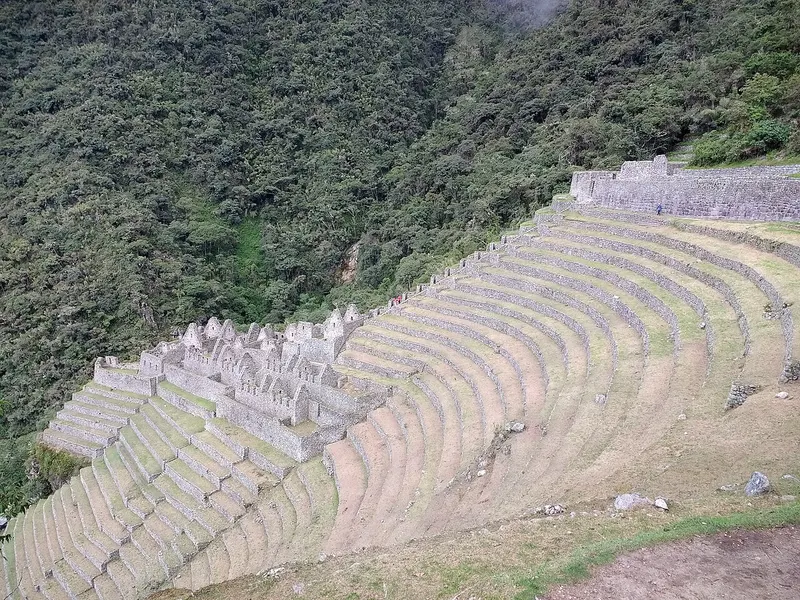
At the pass you are high enough that the weather makes its own rules. Even in the dry season the saddle can be ferociously windy and cold, with the temperature dropping sharply the moment you stop moving and the sweat on your back turns icy. Cloud streams over the ridge and can swallow the view in minutes, then clear just as fast. The smart move is to climb in your sweat-wicking base layers, then pull on a warm layer and a windproof shell the instant you reach the top, before the chill sets in — the most common mistake is standing around at the summit getting cold in damp clothes.
Conditions shift with the season. Dry-season mornings (roughly May to September) give the firmest footing and the best chance of a clear summit, though the high passes are bitterly cold at dawn. The shoulder and wet months bring more cloud, slick stone and the real possibility of rain or even sleet at the top, which makes both the climb and the descent harder and demands proper waterproofs. Whatever the season, treat the pass as a place to move through rather than linger: take your photos, eat something, layer up, and start down before the cold and altitude sap you.

The mental game
Plenty of people who clear Dead Woman's Pass say the hardest part was in their head. Somewhere on the climb, as the stairs keep coming and the air keeps thinning, a voice suggests you cannot do this. That voice is lying. The technique for the mind is the same as for the legs: break the impossible whole into the possible next bit. Do not look up at the pass, still impossibly far above; look at the next ten steps, then the next rock, then the next short rest. The summit arrives, eventually and always, one small section at a time.
It helps to remember that the porters carrying your camp are climbing the same pass with far heavier loads and overtaking you with a smile — proof that the human body manages this with the right adaptation. It helps to remember that the slowest person in a group still reaches the top; the trek is not a race and the guides build in time for everyone. And it helps to know that the feeling at the summit — standing on the high saddle with the whole valley spread below and the worst of the trail behind you — is one of the purest hits of earned joy the trip offers. You climb the pass once; you get to have climbed it forever.
Warning signs to take seriously
Most trekkers feel rough at the pass — breathless, headachy, drained — and that is normal altitude effort, not danger. But altitude sickness exists on a spectrum, and a few symptoms mean stop, not push on. A worsening headache that painkillers won't touch, repeated vomiting, confusion, loss of coordination, or breathlessness that doesn't ease with rest are signs of serious altitude illness, and the only reliable cure is to descend. Tell your guide immediately if you or anyone in the group shows them; guides are trained for this and would far rather turn someone around than gamble. Do not let pride or a paid-for permit push you past your body's limit.
The everyday discomfort, though, is just the price of the view. A headache, heavy legs, breathlessness and the need to stop often are the universal experience of the pass, not a reason to worry. Hydrate, pace yourself, layer up at the top, and trust that the steady slow walk gets you there.
Verify the details
The precise altitude figure, the day-two itinerary and the timings all vary a little between operators and sources, and seasonal conditions change year to year. The character of the climb is constant; the specifics are worth confirming against your operator's itinerary and current conditions before you go.
- Confirm the day-two schedule and pacing with your trek operator's itinerary.
- Check current weather and season conditions before you commit to dates.
- Acclimatize for several days in Cusco and the Sacred Valley before the trek begins.

Related guides

The Classic 4-Day Inca Trail to Machu Picchu
The four-day Inca Trail — the only trek that walks you into Machu Picchu through the Sun Gate. Permits, camps, Dead Woman's Pass, altitude, porters and what each day actually feels like.
Read guide
Altitude in Machu Picchu, Cusco & the Valley
How altitude really works across the trip — why Cusco is higher than the citadel, where soroche hits hardest, the low-to-high-to-low ladder, and sensible pacing, with medical-caution language throughout.
Read guide
What to Pack for Machu Picchu
The full kit for the citadel and the journey to it — cloud-forest rain and Andean sun, the stepped circuits, train luggage limits, altitude, and the hotel-hopping that defines a Cusco–Sacred Valley–Aguas Calientes trip.
Read guideMore in Treks
6Choosing a Licensed Inca Trail Operator
The classic Inca Trail can only be booked through a licensed operator — so the operator is your most important choice. How to vet permits, porter welfare, cancellation terms, and spot a too-good-to-be-true offer.
Read guide
Hiking Gear for Machu Picchu and the Treks
What to actually pack for the Inca Trail, Salkantay, rainy-season trekking, day hikes like Huayna Picchu, and the citadel circuits — the layering system, footwear, rain gear and daypack, without overpacking.
Read guideInca Trail Packing List
Exactly what to bring for the classic four-day Inca Trail — the layering system, rain gear, the sleeping setup, your daypack contents, medication and toiletries, and how the porter duffel weight limit shapes everything.
Read guide
Inca Trail Permits: How They Work and How to Get One
How Inca Trail permits work — who can book them, the strict daily cap, release timing, passport rules, the February closure, and what to do when your dates are sold out.
Read guide
Inca Trail vs Salkantay: Which Trek to Machu Picchu?
A clear head-to-head between the two classic treks to Machu Picchu — permits and availability, scenery, altitude, cost, comfort and archaeology — to help you pick the right one.
Read guidePorter Ethics on the Inca Trail
The people who carry your trek up the mountain — how to choose an operator that pays, feeds, equips and protects its porters, what the load and welfare rules say, and how to tip without insulting anyone.
Read guide