
Ollantaytambo Ruins: Terraces, Temple Hill & the Sun Temple
How to visit Ollantaytambo's terraced fortress — the ticket you need, the climb up Temple Hill, the six monolithic pink-granite blocks of the Sun Temple, the granaries opposite, and how to pair the ruins with a Machu Picchu train.

Photo: Ruben Hanssen / Unsplash
- ✓The fortress is covered by the regional boleto turístico (tourist ticket), not a separate standalone entry — confirm which version of the ticket you hold.
- ✓The signature sight is the Temple Hill: steep terraces climbing to an unfinished Sun Temple and its wall of six monolithic pink-granite blocks.
- ✓Allow roughly one and a half to two hours for a full visit; the terrace climb is short but steep at altitude, so pace it.
- ✓It is one of the few places the Inca beat a Spanish army — Manco Inca flooded the plain below from the channels above in 1537.
The fortress that stopped a conquest
The ruins of Ollantaytambo rise straight out of the town's western edge, a great staircase of stone terraces climbing the mountainside to a ceremonial plateau. They are usually called a fortress, and they did serve as one — this is one of the very few places the Inca decisively defeated a Spanish force during the conquest — but they were first and foremost a temple complex and a royal estate, a place of worship and engineering as much as defence. Standing at the foot of the terraces and looking up, you understand at once why the Spanish cavalry failed to take it.
What makes the site extraordinary is not only its scale but its craftsmanship and its unfinished state. The Inca were still building here when the empire fell, and the abandoned work-in-progress — half-dressed stones, ramps for hauling blocks, a temple wall left incomplete — lets you read the construction process in a way that a finished monument never could. It is a rougher, steeper, less polished sibling of Machu Picchu, and seeing it first changes how you read the citadel.

At a glance
The practical shape of a visit. The ticket structure and altitudes below are stable, but prices and exact hours change — verify them with the official sources before you go.
- Ticket: covered by the boleto turístico (Cusco tourist ticket), which bundles several Sacred Valley and Cusco sites — there is no separate standalone fortress ticket. Verify the current version and price.
- Time needed: about 1.5–2 hours for the terraces, the Sun Temple plateau and the lower temple area.
- Effort: a steep terrace climb of a few hundred steps at around 2,790 m — short, but breathless if you rush.
- Best time: early morning or late afternoon, before or after the Cusco day-trip coaches.
- Opposite hillside: the free Pinkuylluna granaries (qollqas), a steeper, rougher walk with the best aerial town view.
- Pairing: the fortress sits a short walk from the train station, so it pairs naturally with a Machu Picchu departure.
Tickets — what the boleto turístico covers
Ollantaytambo's fortress is not sold as a single standalone entry. It is one of the sites bundled into the boleto turístico, the regional tourist ticket administered for the Cusco region, which also covers places such as Pisac, Chinchero, Moray and a number of sites in and around Cusco itself. There are different versions of the ticket — a full multi-day pass and shorter partial circuits that group particular sites — so the right one depends on which other ruins you plan to visit on your trip.
Because prices, validity periods and exactly which sites each circuit includes are set by the regional authorities and can change, treat the specifics as something to confirm rather than memorise. The durable advice is simply this: work out which Sacred Valley and Cusco sites you actually want to see — Ollantaytambo, Pisac, Moray, Chinchero, Sacsayhuamán and so on — and then buy the version of the boleto that covers them most economically. Keep the ticket safe; it is checked at each site's entrance and is not re-issued if lost.
Climbing Temple Hill
The visit is essentially a climb. From the entrance you mount the broad terraces — the andenes that the Inca used both to farm the steep slope and to glorify the temple above — by a long stone staircase that switches up the hillside. There are a few hundred steps; at nearly 2,800 metres they will leave you breathing hard if you charge them, so the trick is simply to go slowly and stop to look back. Each landing opens a wider view over the town's grid, the green valley floor and the snow on the far peaks.
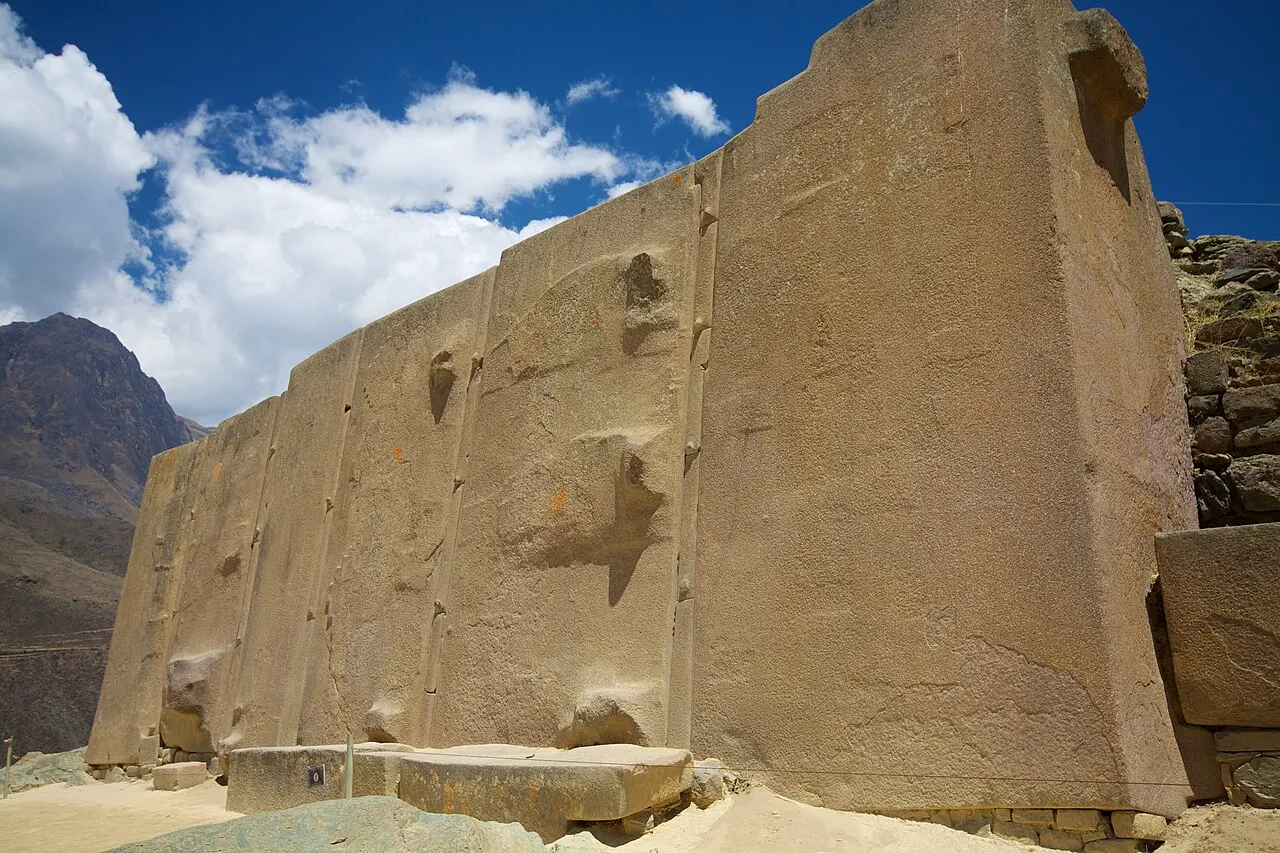
At the top sits the ceremonial heart of the complex: the unfinished Sun Temple, dominated by its astonishing wall of six colossal monoliths of rose-coloured rhyolite, each many tonnes, fitted edge to edge and separated by thin spacer stones. The stone was quarried from a mountainside several kilometres away across the valley and river — the haulage alone, by ramp and human muscle, is one of the great puzzles of Inca engineering. You can still trace, on the far slope, the abandoned blocks that never completed the journey.

The water temple, the fountains and the granaries
Below and to the side of the main climb lie the parts many visitors miss in their hurry to the top. A series of beautifully cut ceremonial fountains and channels — the so-called Princess's Bath (Baño de la Ñusta) among them — still runs with water, a reminder that Ollantaytambo, like Machu Picchu, was as much a temple to water as to the sun. The fitted stonework around these fountains is some of the finest on the site and rewards a slow, close look.
Across the valley on the bare hillside opposite the fortress stand the Pinkuylluna granaries, tall Inca storehouses (qollqas) built high to catch the cold, dry wind that preserved grain. The walk up to them is free and separate from the fortress ticket, and it is steeper and rougher — proper footwear helps — but it gives the single best aerial view of the whole town grid and the terraces opposite. If you have the legs and an extra hour, it is the finest free vantage in town.
Altitude and effort — pacing the climb
The fortress sits at around 2,790 metres, lower than Cusco but high enough that the terrace climb can feel surprisingly hard if you have only just arrived in the Andes. Most of the effort is concentrated in the staircase up Temple Hill, which is short in distance but steep and stepped throughout. The remedy is the same as everywhere on this trip: go slowly, drink water, and treat the frequent view-stops as part of the experience rather than an admission of weakness.
If altitude has troubled you in Cusco, take heart — Ollantaytambo is part of the descent, not the climb, and a night spent here before the citadel actively helps your acclimatization. Bring sun protection (the high-altitude sun is fierce even when the air is cool), a warm layer for the breeze on the plateau, and shoes with grip for the worn, sometimes slick stone. There is no need to hurry; the whole site is comfortably done in under two hours at a gentle pace.

Pairing the ruins with your Machu Picchu train
Ollantaytambo's great convenience is that the fortress and the railway station sit a short walk apart, which lets you fold the ruins neatly into the journey to the citadel. The classic plan is to arrive in town in the afternoon, climb the fortress and wander the old streets in the soft late light, sleep in town, and catch an early train down the gorge the next morning. The ruins become a beautiful prologue to Machu Picchu rather than a separate excursion.
If you are tighter on time and only passing through on the day of your train, it is still possible to see the fortress before you board, provided you allow a generous buffer — the climb takes longer than people expect, and you do not want to be sprinting for a train at altitude. Whichever way you do it, leave your large bag with your hotel or a luggage store and carry only a small train-legal bag, and have the passport your ticket was booked under to hand for the boarding check.


Common questions about visiting Ollantaytambo ruins
A few things travellers most often ask, kept evergreen — confirm the moving details with official sources before you travel.
- Do I need a separate ticket? No — the fortress is covered by the boleto turístico, not a standalone entry. Verify which version covers it.
- How long does it take? About 1.5–2 hours for a full visit, more if you add the Pinkuylluna granaries opposite.
- Is it a hard climb? Steep but short — a few hundred steps at ~2,790 m. Go slowly and you will be fine.
- Do I need a guide? Not required, but a guide brings the engineering, the 1537 battle and the temple's meaning to life; many hire one at the gate.
- Can I visit on the way to Machu Picchu? Yes — the ruins are a short walk from the train station, so they pair naturally with a citadel departure.
- When is it quietest? Early morning and late afternoon, around the Cusco day-trip coaches.



Related guides
Boleto Turístico del Cusco
How the COSITUC Boleto Turístico works — the combined pass that covers Sacsayhuamán, Pisac, Ollantaytambo, Moray, the Maras–style sites and a clutch of Cusco museums — and when it's actually worth buying.
Read guide
Ollantaytambo: A Living Inca Town Guide
The Sacred Valley's most atmospheric staging base — a fortress town where the Inca street grid is still lived in, the train to Machu Picchu departs, and an early citadel morning becomes a short walk to the platform.
Read guide
Pisac Ruins: Terraces, Temples & Cliff Tombs
How to visit the great cliffside Inca complex above Pisac — the ticket you need, the sweeping terraces, the Intihuatana sun temple, the cliff tombs, the steep hike from town, guide advice and how to pair the ruins with the market.
Read guide